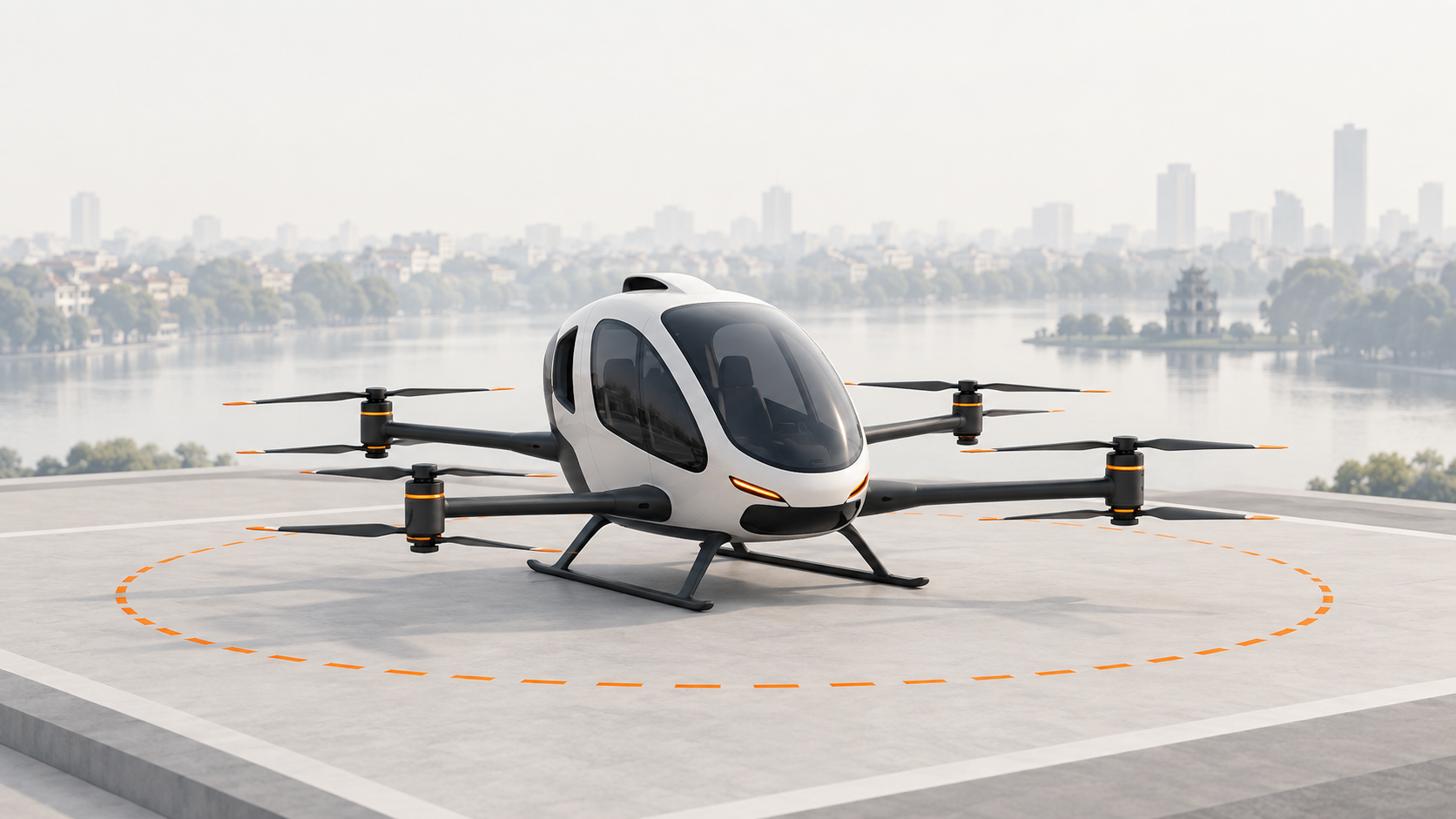
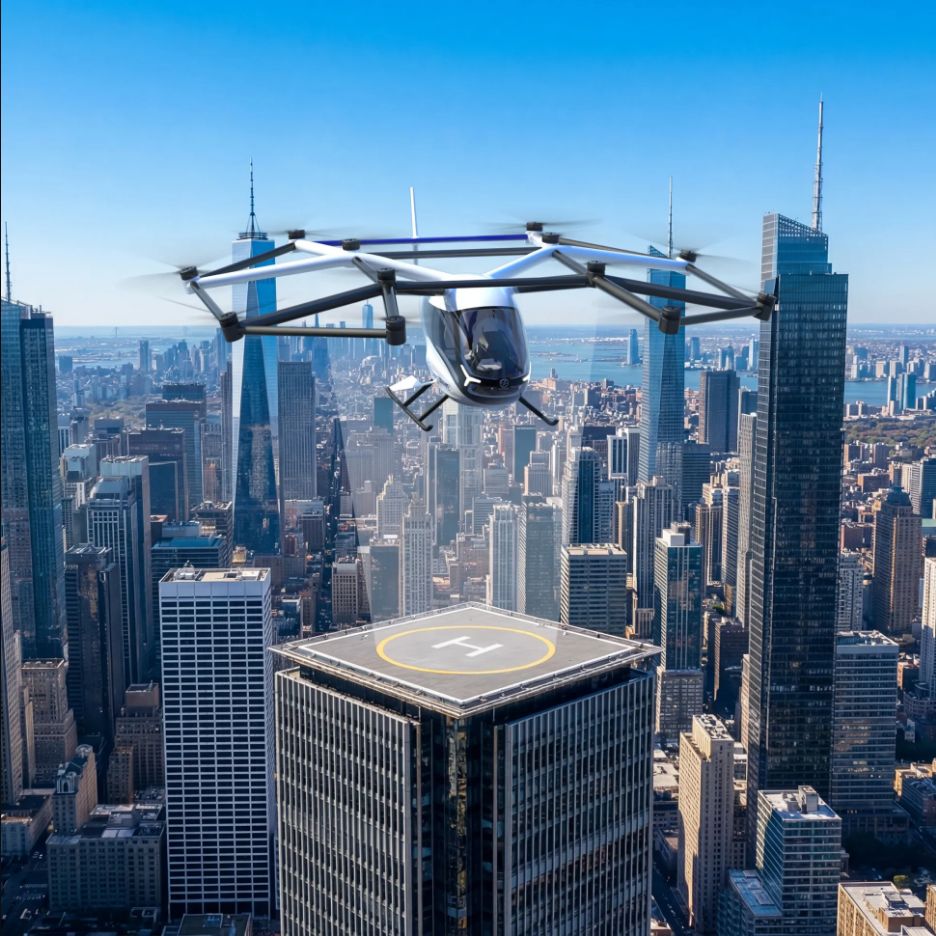
SkyDrive has published its engineering case for a 12-rotor, wingless SD-05: low disk loading to cut hover power, and enough rotors and battery packs that losing one still leaves margin for a vertical landing. We run the numbers and set out what the layout gives up.
12 rotors, 4 battery systems (manufacturer-published) ~1.4 t published SD-05 weight ~217 kW vs ~396 kW: illustrative hover power at 300 vs 1,000 N/m² disk loading +14%: minimum extra power per surviving rotor after one motor out (12 rotors) vs +54% with 4
Rotor count and disk loading decide how much installed power a VTOL must carry just to survive a motor or battery failure in the hover. SkyDrive is betting that a hover-optimised, many-rotor layout is the lightest way to meet that requirement for short city hops.
Published SD-05 disk loading, motor and inverter emergency ratings, end-of-flight pack discharge rates, and progress against the agreed JCAB General Certification Plan.
SkyDrive published a short design paper on 24 September 2026 explaining why the SD-05 uses 12 rotors and no wing, rather than the tilt-rotor or lift-plus-cruise layouts chosen by most Western programmes. The argument rests on one parameter, disk loading, and on one safety requirement: if a motor or a battery pack fails, the aircraft must still complete a controlled vertical landing, because an urban vertiport has no runway to glide onto.
SkyDrive frames the SD-05 around sub-30 km city hops, where hover, approach and landing make up a large share of every flight. For that mission, it argues, the powertrain should be sized for hover rather than cruise. The architecture background is covered in our explainers on multicopter, lift + cruise and vectored-thrust trade-offs and distributed electric propulsion redundancy. This piece focuses on what the paper adds.
Disk loading is aircraft weight divided by total rotor disk area. In momentum theory, ideal hover power is P = T·√(DL/2ρ), so at a given weight, hover power grows with the square root of disk loading. Doubling rotor area cuts ideal hover power by about 30%.
At SkyDrive's published 1.4 t mass, with a typical rotor figure of merit of 0.7, a disk loading of 300 N/m² needs roughly 217 kW to hover at sea level. At 1,000 N/m², the requirement is roughly 396 kW. SkyDrive has not published the SD-05's disk loading, so these figures show the size of the effect rather than the aircraft's actual rating. The difference has to be carried as motor, inverter and, above all, battery power capability. That is why the paper separates energy density, which sets range, from power density, which sets whether the pack can deliver hover power at the end of a flight, when cell voltage is lowest and the aircraft needs the most power to land.
The failure argument is where rotor count and disk loading interact. With N equal lift rotors, losing one forces each survivor to raise its thrust by N/(N−1). At a fixed disk area, its power rises by that factor to the 1.5 power:
These are lower bounds. When one rotor stops, the controller also has to cancel the roll, pitch and yaw moment it leaves behind, so the rotors nearest or opposite the failure work harder than the average. The direction still holds: more rotors and lower disk loading reduce how far each motor and inverter must be oversized for the emergency case, and the step starts from a lower baseline.
The same logic applies to the battery. SkyDrive publishes four battery systems for the SD-05. If one drops out, the remaining three have to supply a third more current each. A pack sized with power headroom can do that. A pack already working hard in normal hover cannot.
A wingless aircraft keeps its rotors producing lift throughout cruise, so it cannot match the cruise efficiency of a winged design flying at 150+ km/h. That is the price of the SD-05's short-range focus, and the reason Joby, Archer and Vertical accept higher disk loading in exchange for wing-borne cruise. Low disk loading also means a large total rotor span. SkyDrive publishes an 11 m width, which sets the pad size. Twelve motors and inverters add parts to qualify and maintain, even though each matters less. In the SD-05's favour, lower disk loading generally means lower induced velocity, less downwash on the pad and lower rotor noise.
A winged aircraft that loses a propulsor in cruise can lean on its wing. A multirotor has to cover the continued-safe-flight-and-landing case with rotor power margin alone, in every phase of flight. SkyDrive's paper is effectively a public explanation of how its sizing approach is meant to meet that requirement under its JCAB type-certification programme.
The numbers that would test the argument have not been published: the SD-05's actual disk loading, the emergency power rating of its motors and inverters, and the pack discharge rate at end of flight. If the disk loading is close to helicopter levels, the power-margin case is strong. If it is closer to tilt-rotor territory, the case rests more on redundancy through rotor count than on hover efficiency. Either way, the paper points to a market split rather than one winning architecture, with multirotors serving hover-heavy city shuttles and winged designs serving routes of 100 km or more.
Sources: SkyDrive, design paper announcement, 24 September 2026; Urban Air Mobility News, 24 September 2026; SkyDrive SD-05 technical page. Power figures are PropulsionWatch momentum-theory illustrations, not SkyDrive data.