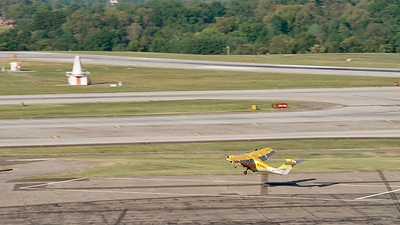
Joby says its Superpilot-equipped Cessna Caravan crossed the U.S. with no control inputs from the onboard safety pilot, while remaining under remote supervision. The result is evidence for the autonomy stack on a conventional certified airframe, not an autonomous-certification milestone for Joby’s S4.
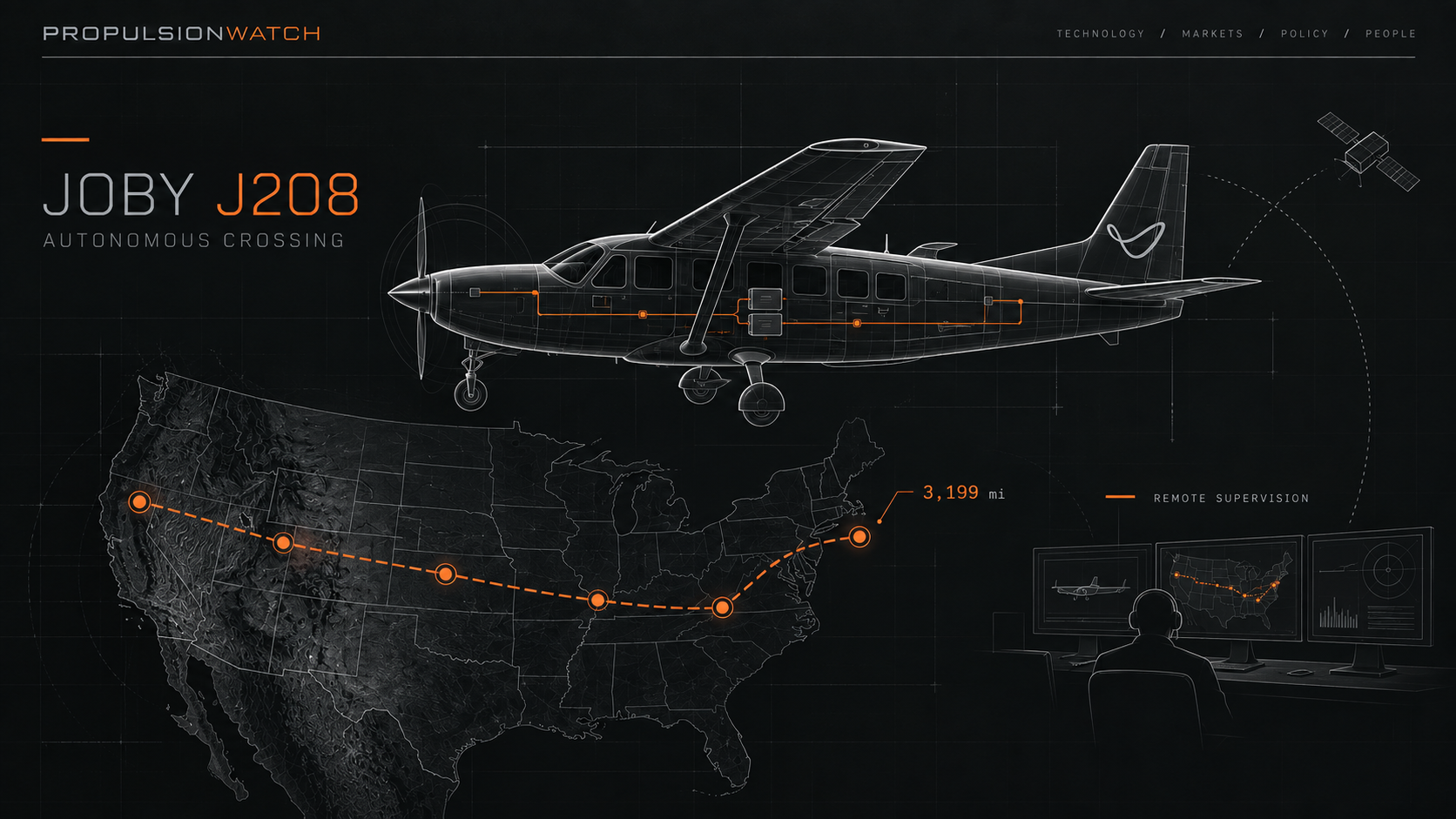
3,199 mi — transcontinental eastbound route reported by Joby 0 — onboard safety-pilot control inputs reported during the crossing 2,323 mi — maximum remote-supervision distance reported by Joby
The flight gives Joby a long-distance operational data point for supervised autonomy on a mature conventional aircraft. It should not be conflated with autonomous certification of the J208 or with the separate FAA type-certification program for Joby’s S4.
Off-nominal performance, intervention and dispatch data, lost-link behaviour, remote-operator workload and any FAA approvals that reduce onboard piloting requirements for autonomous logistics operations.
Joby Aviation says its J208, a Cessna Caravan modified with the company’s autonomy system, completed a 3,199-mile eastbound crossing of the United States without control inputs from the safety pilot onboard. The aircraft performed taxi, takeoff, route navigation and landing automatically while being supervised remotely from ground locations, including sites as far as 2,323 miles away.
Aviation Week independently reported the crossing on 18 September, while attributing the “first autonomous transcontinental flight” characterization and the zero-input claim to Joby. That distinction matters: the flight is a substantial operational demonstration, but the evidence currently available is primarily company-reported performance from a supervised campaign.
The J208 carried an onboard safety pilot. Joby’s earlier description of the operating model also identifies a ground-based remote pilot who supervises the flight, can update flight plans and manages air-traffic-control communications. The aircraft’s automation therefore covered the physical flight-control task across taxi, takeoff, cruise and landing, while people remained in the operational loop.
For engineering assessment, that is still useful evidence. A system that can repeat those flight phases across a multi-stop route has to integrate navigation, guidance, flight controls, communications, health monitoring and ground supervision over changing terrain, weather and airport environments. What the public evidence does not establish is how the system performs across the full set of abnormal, degraded and failure conditions that a certificated autonomous commercial operation would need to address.
Using an already-certified conventional aircraft separates the autonomy experiment from many of the development variables present in a clean-sheet advanced-air-mobility aircraft. The propulsion system, aerodynamic configuration and baseline aircraft handling qualities are mature; the principal new system under examination is the autonomy and supervision layer integrated onto that airframe.
That makes the J208 a useful route toward operational evidence for autonomous logistics. It does not mean the modified aircraft is approved for unsupervised commercial service, and the crossing should not be read as approval of a new autonomous-aircraft category.
Joby’s S4 electric air taxi is pursuing its own FAA type-certification path. The J208 crossing is not a Stage 4 or Stage 5 compliance milestone for the S4, and it does not show that the S4 is being certificated for autonomous passenger operations. The relevant evidence streams should remain separate: one concerns autonomy demonstrated on a Caravan platform; the other concerns the aircraft-level certification of Joby’s electric powered-lift design.
The strategic overlap is narrower and more defensible. Joby now has a flight-tested autonomy stack operating in real airspace on a conventional aircraft, while the company is separately developing electric-aircraft operations. Whether, when and under what certification basis those technology streams converge remains unresolved.
The next useful disclosures are not simply more miles. More informative evidence would include performance during off-nominal events, dispatch and intervention rates, lost-link behaviour, remote-supervision workload, weather and airport limitations, and the approval basis for any operation that reduces or removes onboard piloting responsibility.
Evidence note: 3,199 miles, zero onboard safety-pilot control inputs and remote supervision up to 2,323 miles are Joby-reported figures. Aviation Week reported the event independently but preserved the attribution of those claims to the company.
Sources: Aviation Week, 18 September 2026; Joby Aviation, 18 September 2026.