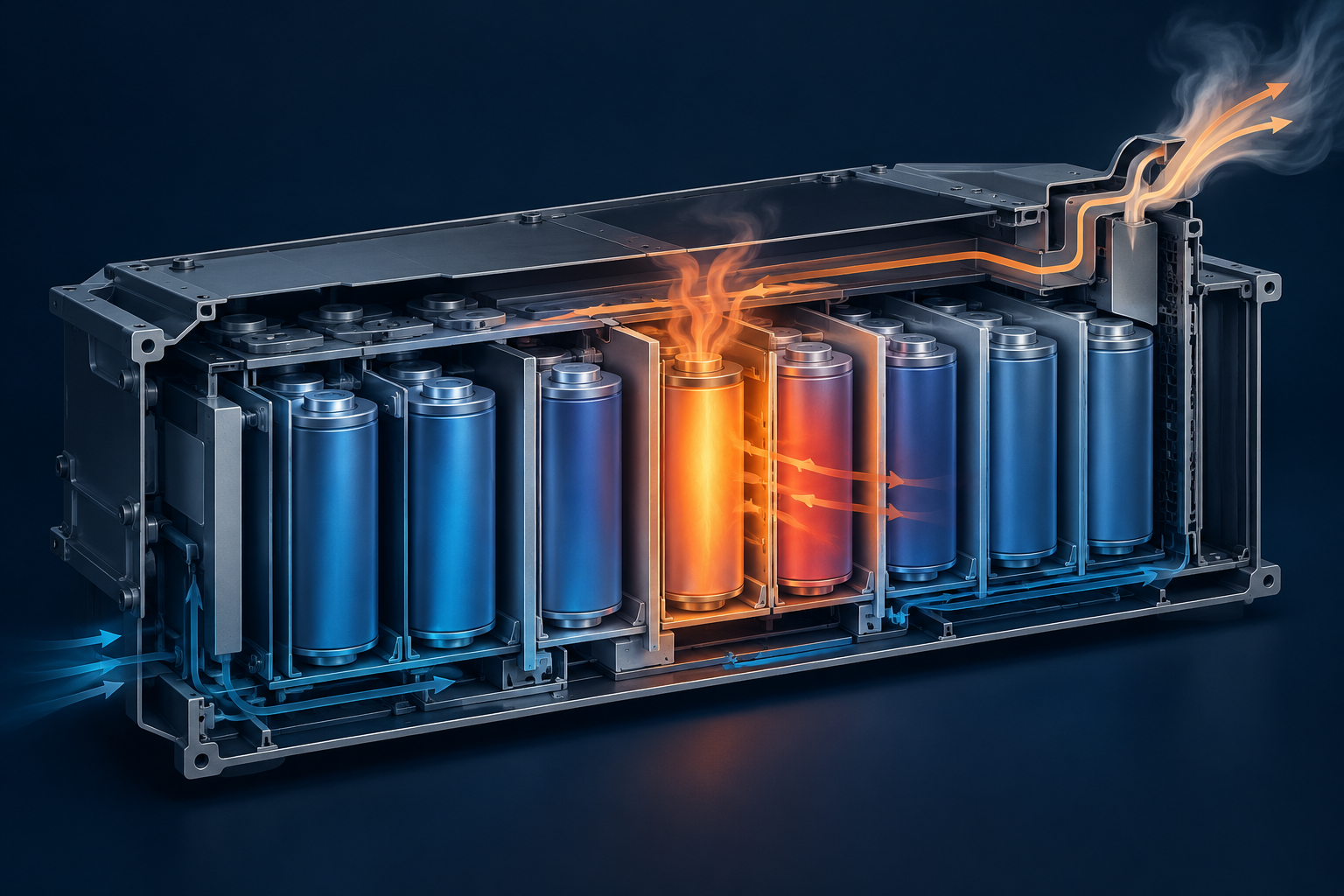
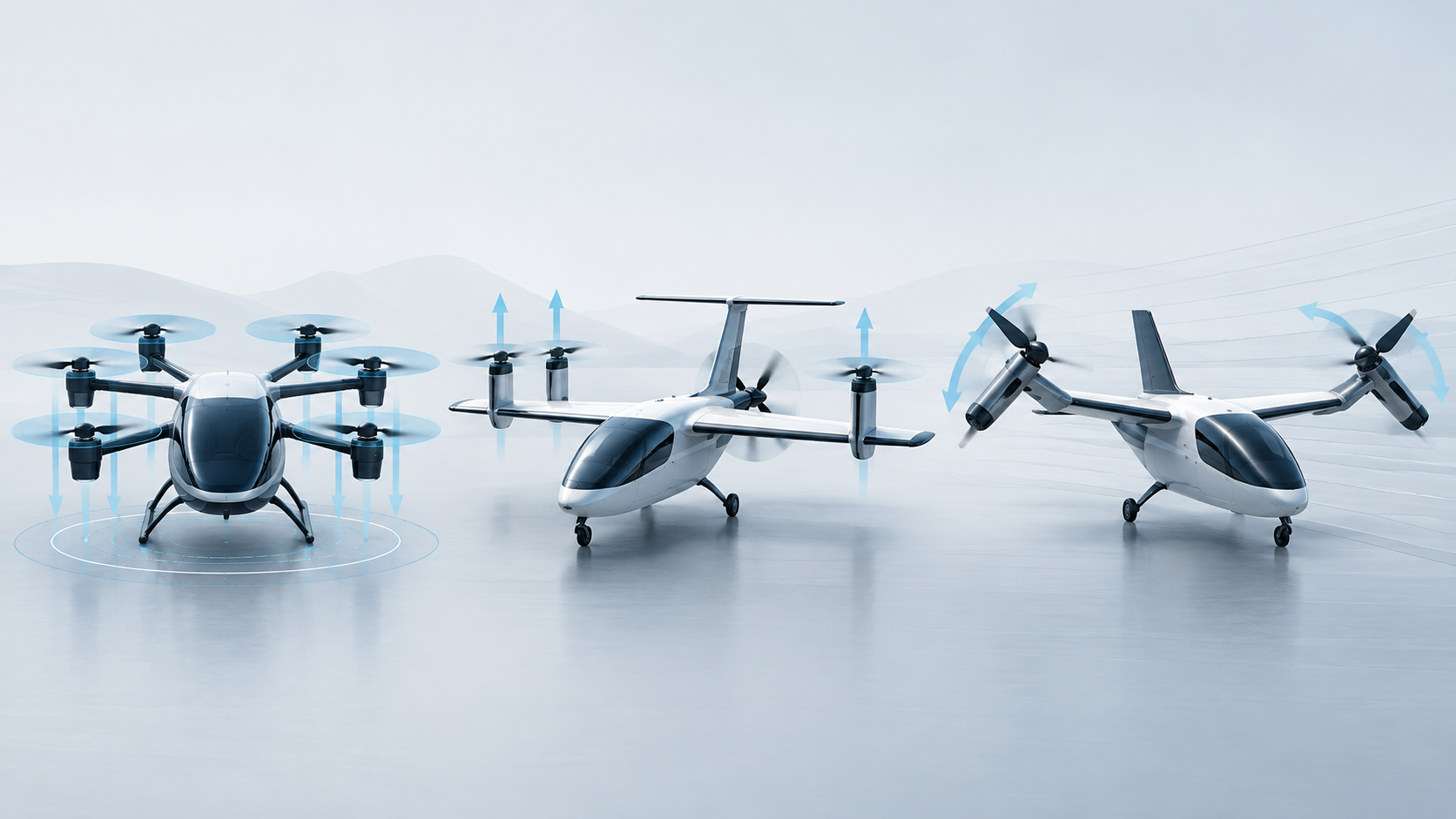
In a series hybrid, generator and battery power must satisfy the electrical load while preserving later mission capability. Generator sizing, transient response, charging losses and failure cases make power sharing an aircraft-level control problem.

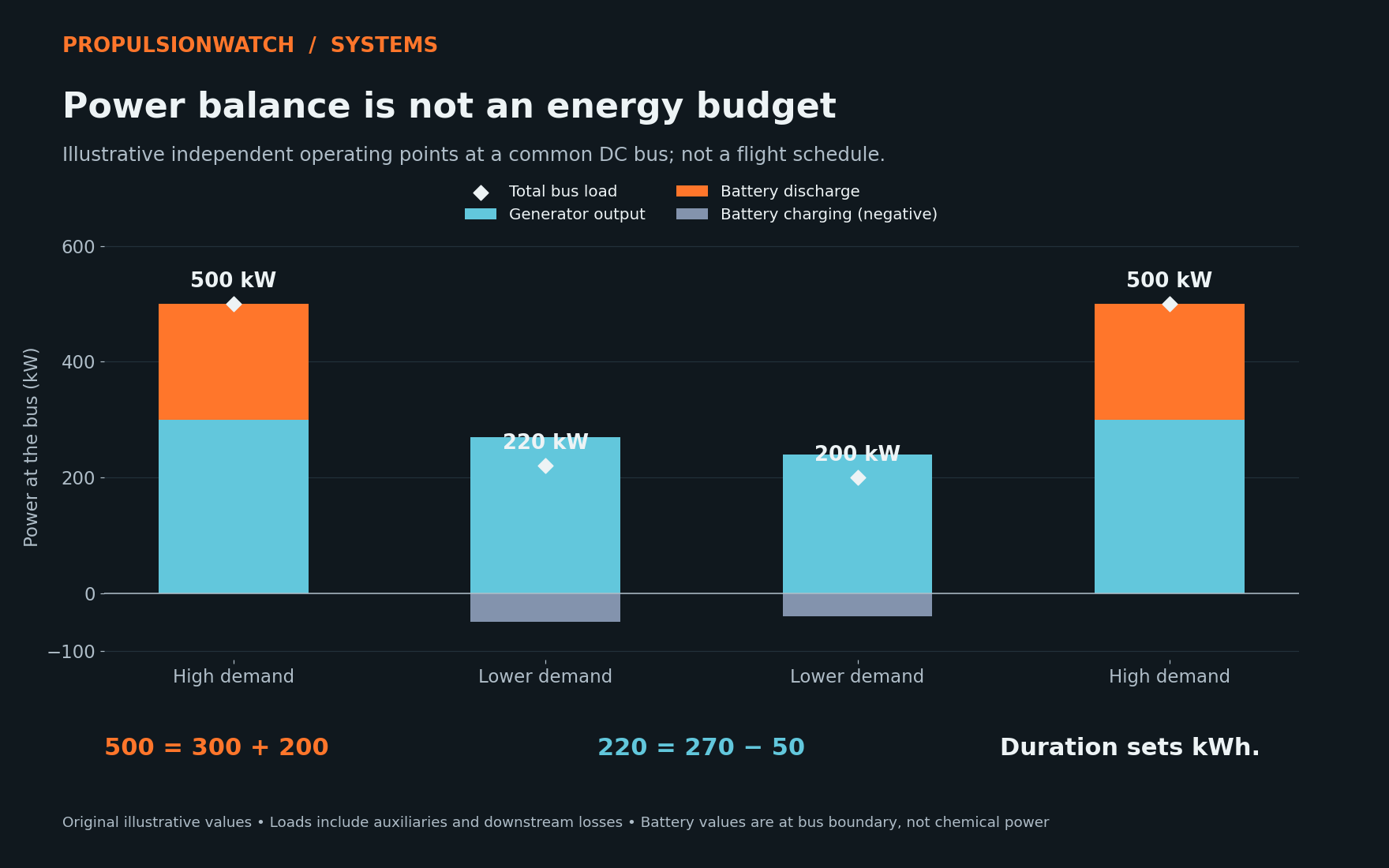
300 + 200 = 500 kW — illustrative generator and battery contributions at one bus 6.7 kWh — bus energy from a 200 kW battery contribution lasting two minutes, before upstream losses 800 V / 350 kW — EcoPulse battery ratings reported by its project partners; not universal hybrid specifications
A generator's headline rating does not establish how much power remains available for a later high-demand segment or after a failure.
Common-boundary power maps, battery replenishment over the mission, verified transient limits and demonstrated capability after loss of an energy source.
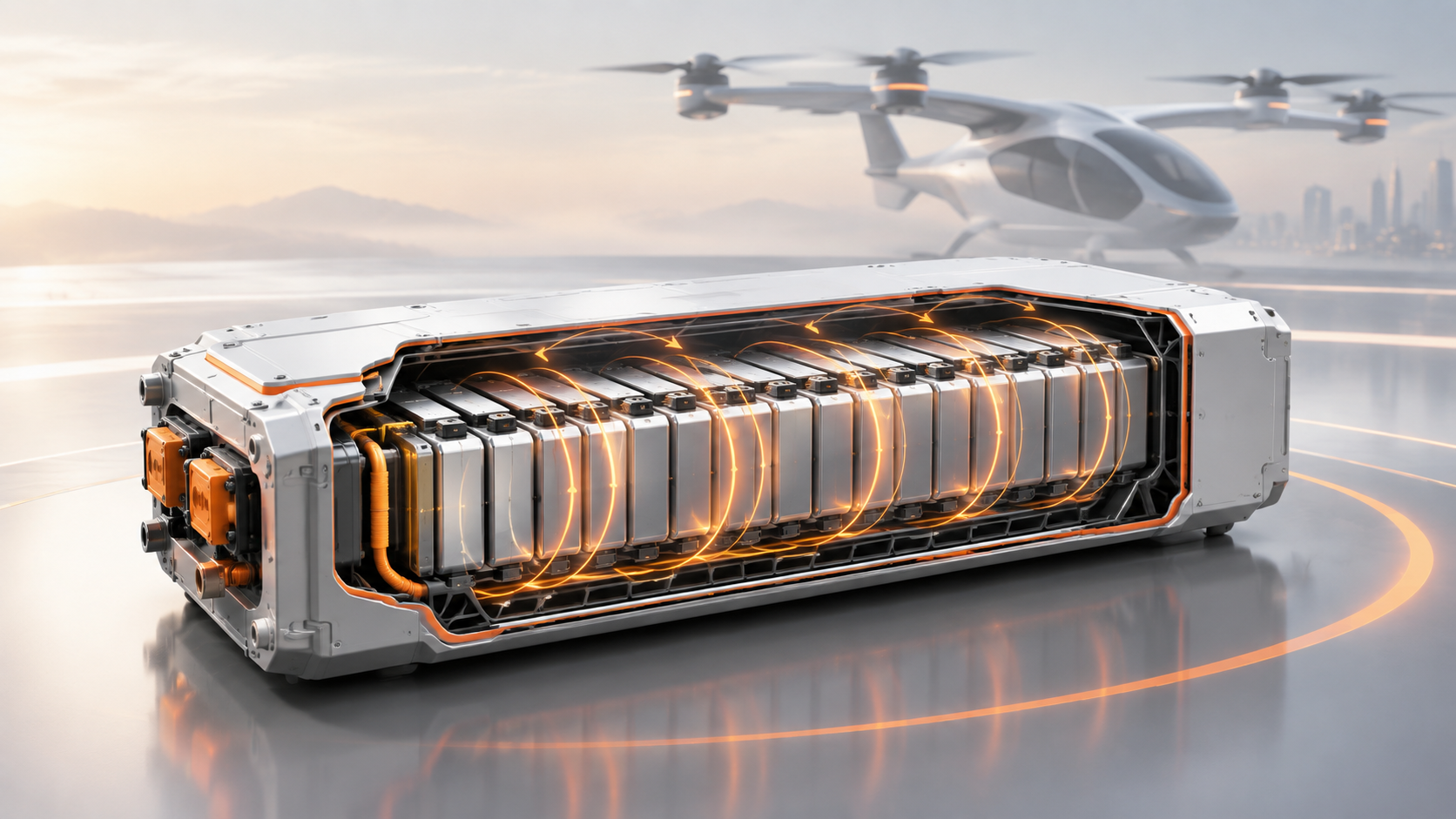
A hybrid-electric aircraft has more than one energy source, but those sources do not automatically add up to usable propulsion at every moment. A turbine generator may supply sustained electrical power while a battery supports higher demand. The control system must also consider what the battery will need to do later.
That makes power sharing part of aircraft capability. The useful questions are where power is measured, which constraints apply now, and what energy and power must remain available for the rest of the mission.
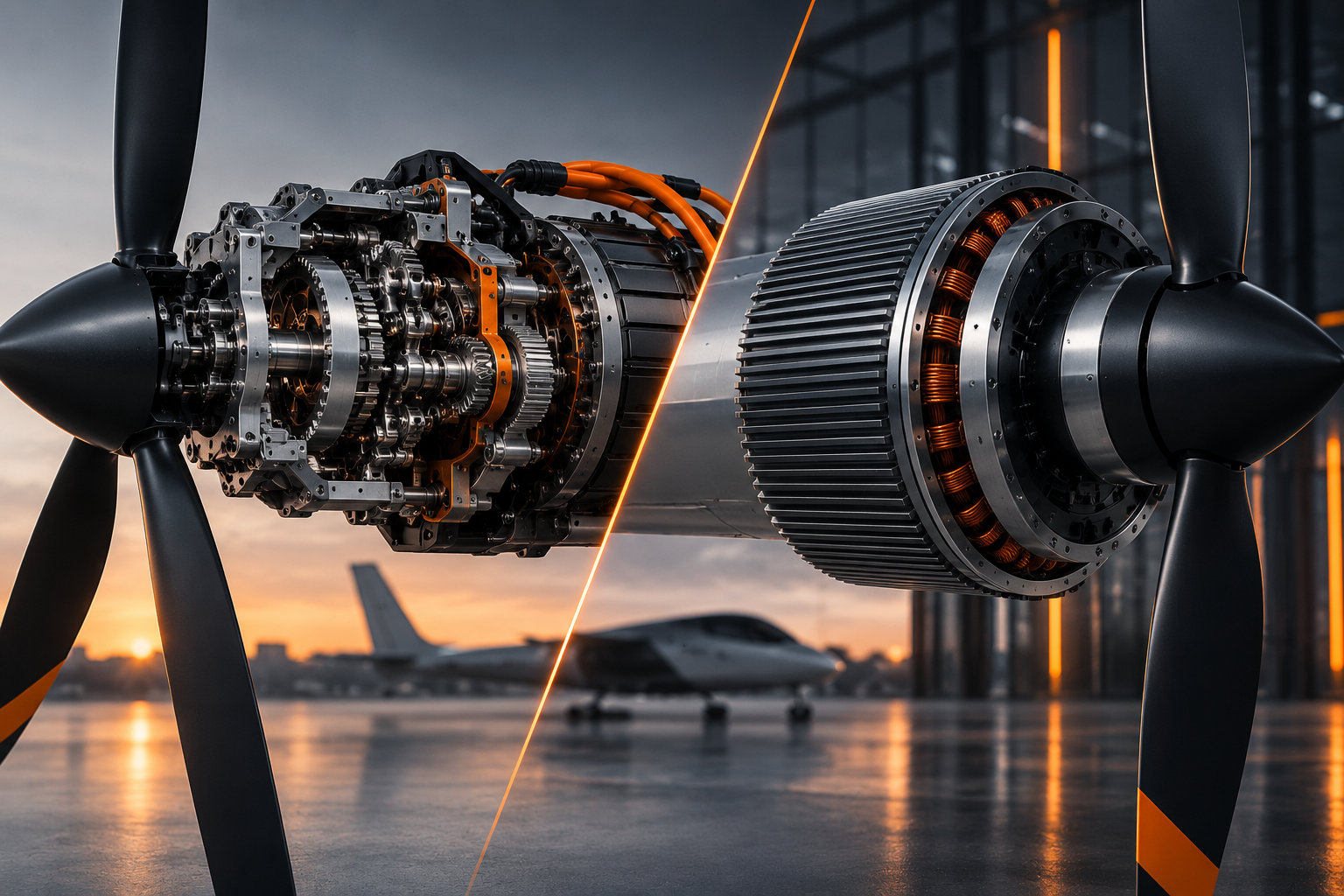
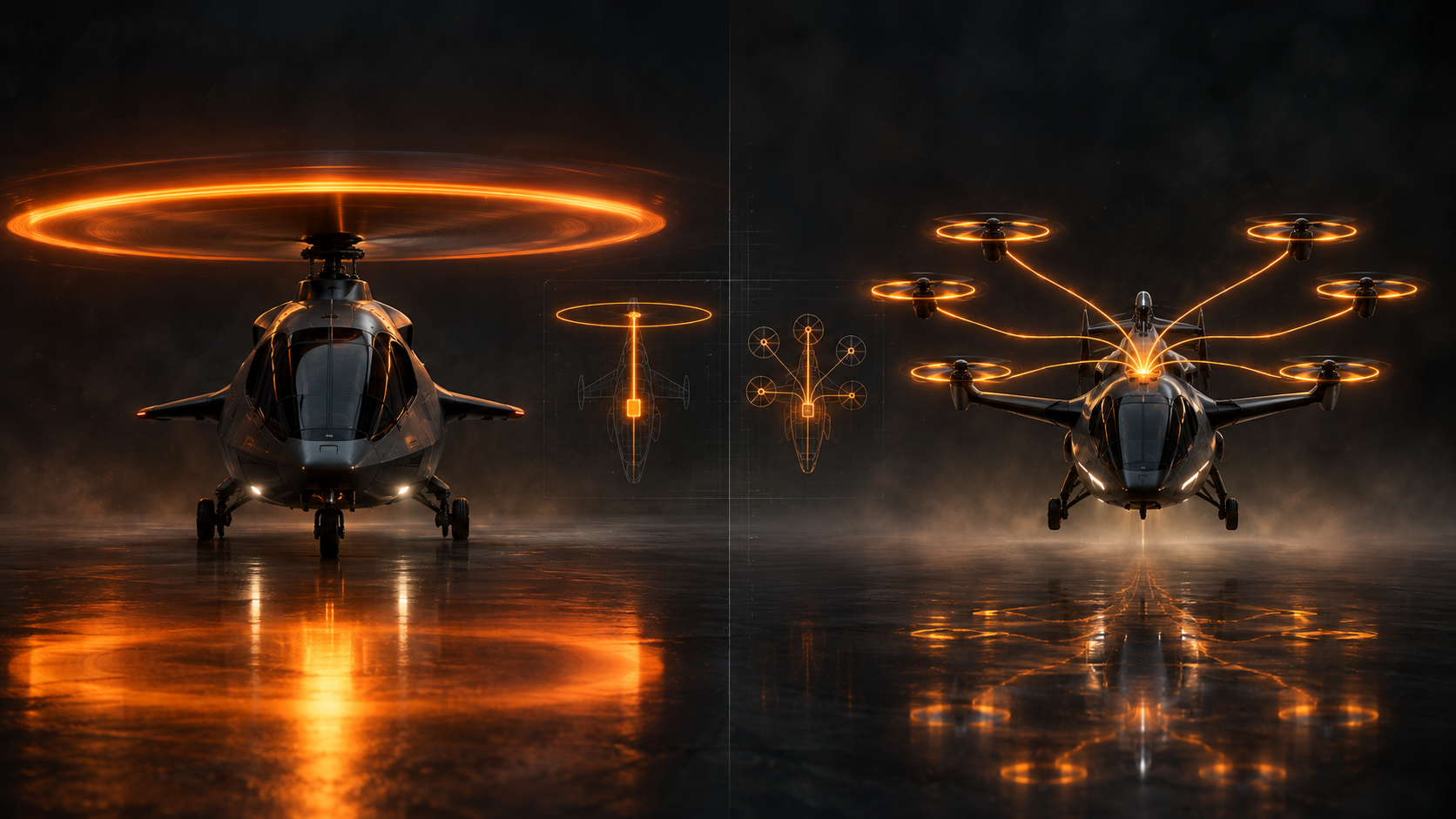
NASA distinguishes series and parallel hybrids by their mechanical power paths. In a series hybrid, electric motors drive the propulsors and an engine drives a generator. In a parallel hybrid, engine and electric-machine torque can both reach a propulsion shaft. A turboelectric system is different again: it does not use a propulsion battery as a flight-energy source in NASA's classification.
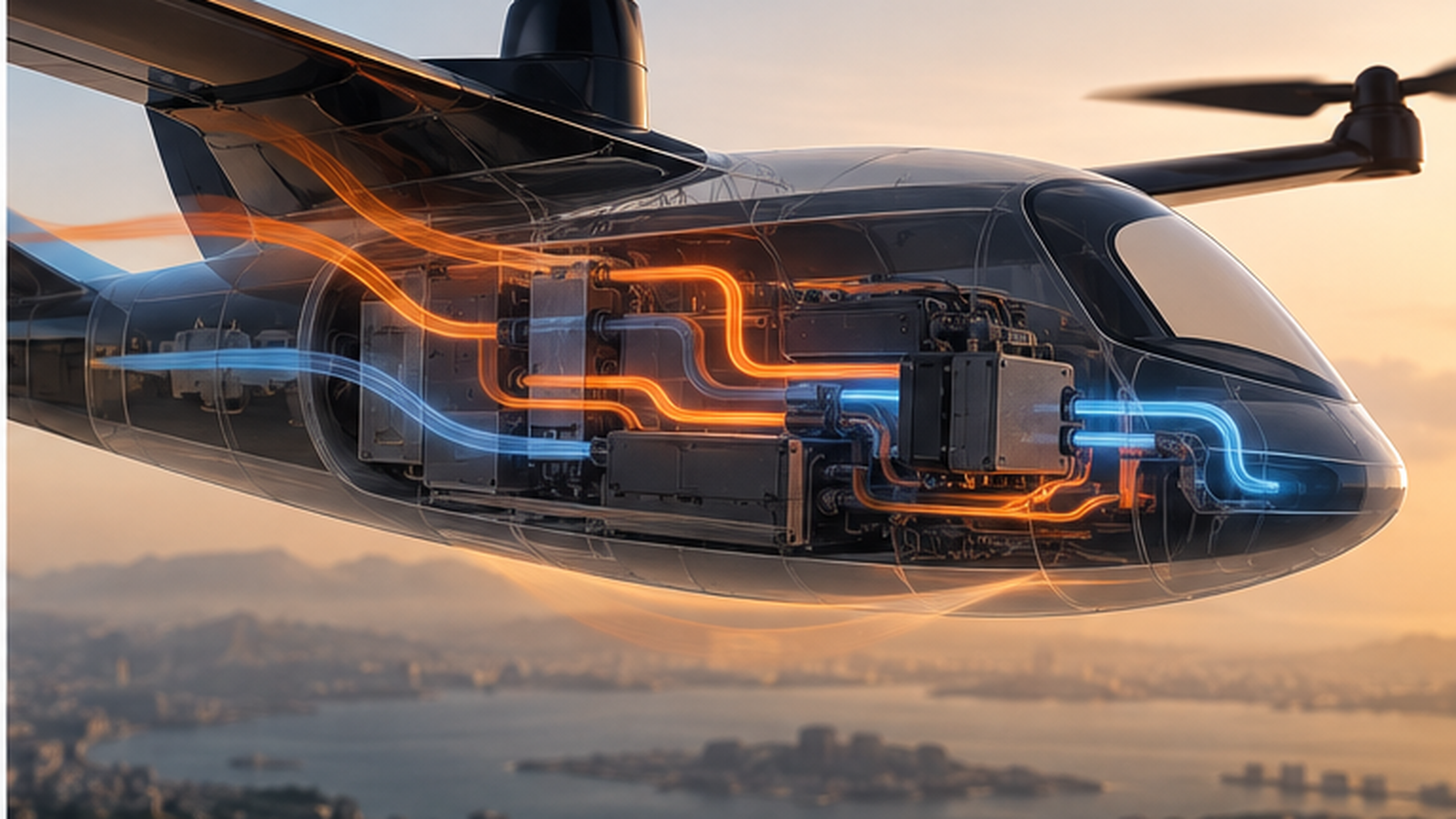
For the simplified series arrangement shown here, define generator and battery contributions at the same DC-distribution boundary. Positive battery power means discharge; negative means charging. The balance is Pgenerator + Pbattery = Ppropulsion + Pauxiliaries + Pdownstream losses. Generator mechanical input, battery chemical power and motor-shaft output sit at different boundaries.
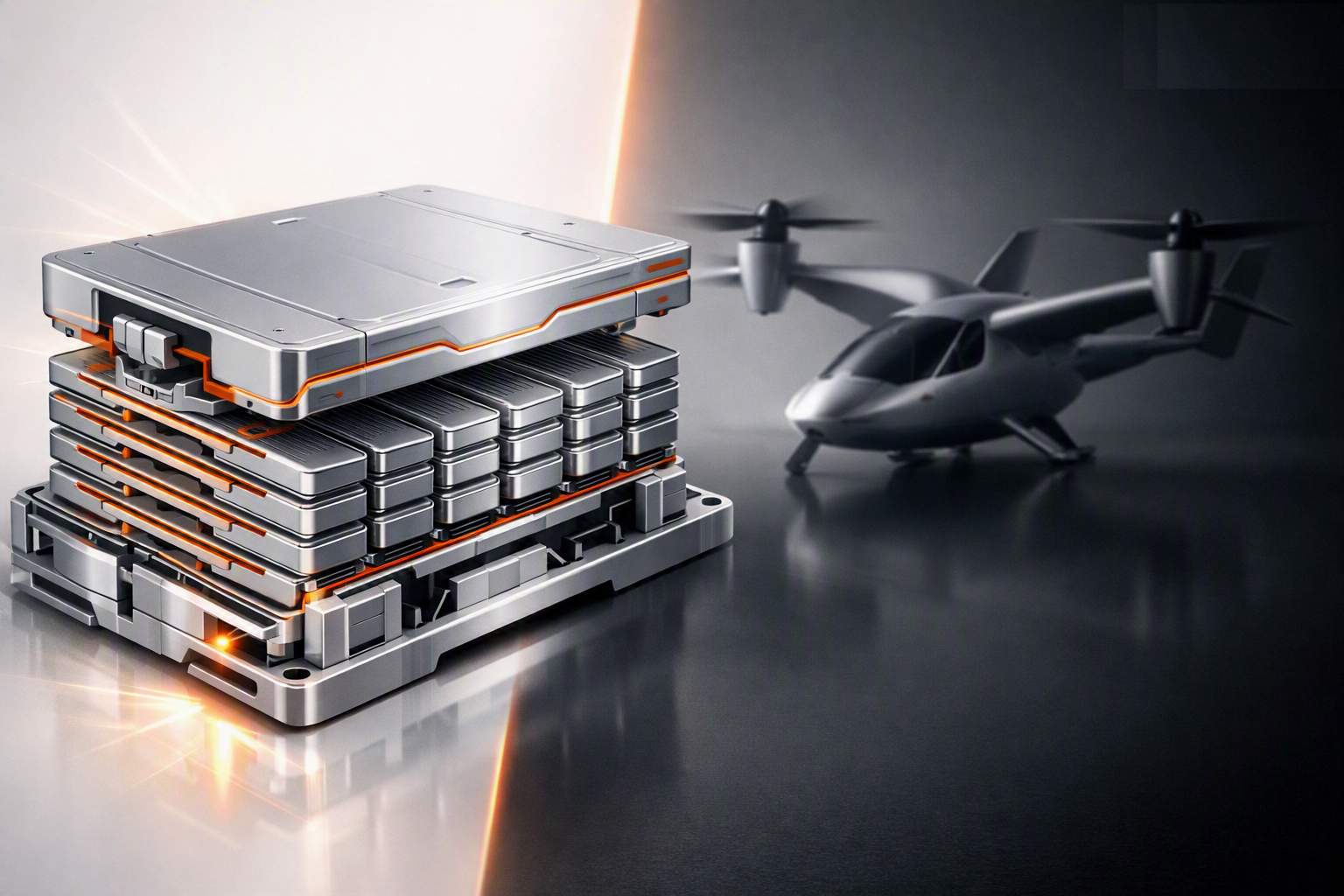
Suppose the total bus load is an illustrative 500 kW and the generator supplies 300 kW at that boundary. The battery must provide 200 kW. Sustaining that contribution for two minutes delivers 6.7 kWh to the bus. The battery's stored-energy depletion is greater once its own and any interface losses are included.
If a later lower-demand condition allows 270 kW of generator output against a 220 kW load, 50 kW can flow toward charging at the bus boundary. That is an opportunity to replenish energy, subject to charging limits and losses. The difference between two nameplate ratings does not establish how long that condition lasts.
A demand change is not just a new steady-state operating point. NASA's 2026 turbine-transient study explains how rotational inertia, gas-path storage, thermal masses and electrical storage interact in an electrified gas turbine. Managing electrical loading can influence turbine operability during a change in power.
A battery can be assigned part of a transient demand, but its contribution remains bounded by its state and electrical interface. The turbine's permissible loading trajectory also matters. No universal generator ramp time or battery-buffer size follows from NASA's study; those must come from the particular system.
Doff-Sotta, Cannon and Bacic formulate predictive energy management for series and parallel hybrid aircraft. Their controller allocates power along a future flight path while respecting battery and powertrain constraints and accounting for losses. The optimisation is updated as the system state changes.
This explains the role of a supervisory controller: it can assess the consequences of using battery energy now rather than only meeting the immediate demand. The research is a model-based control study. It does not establish that a particular production aircraft uses the algorithm or achieves a given fuel saving.
NASA's separate SUSAN concept-control work shows another layer of coordination between distributed propulsion, flight controls and failure response. SUSAN is a series/parallel transport concept; its architecture should not be confused with the generic pure-series diagram above.
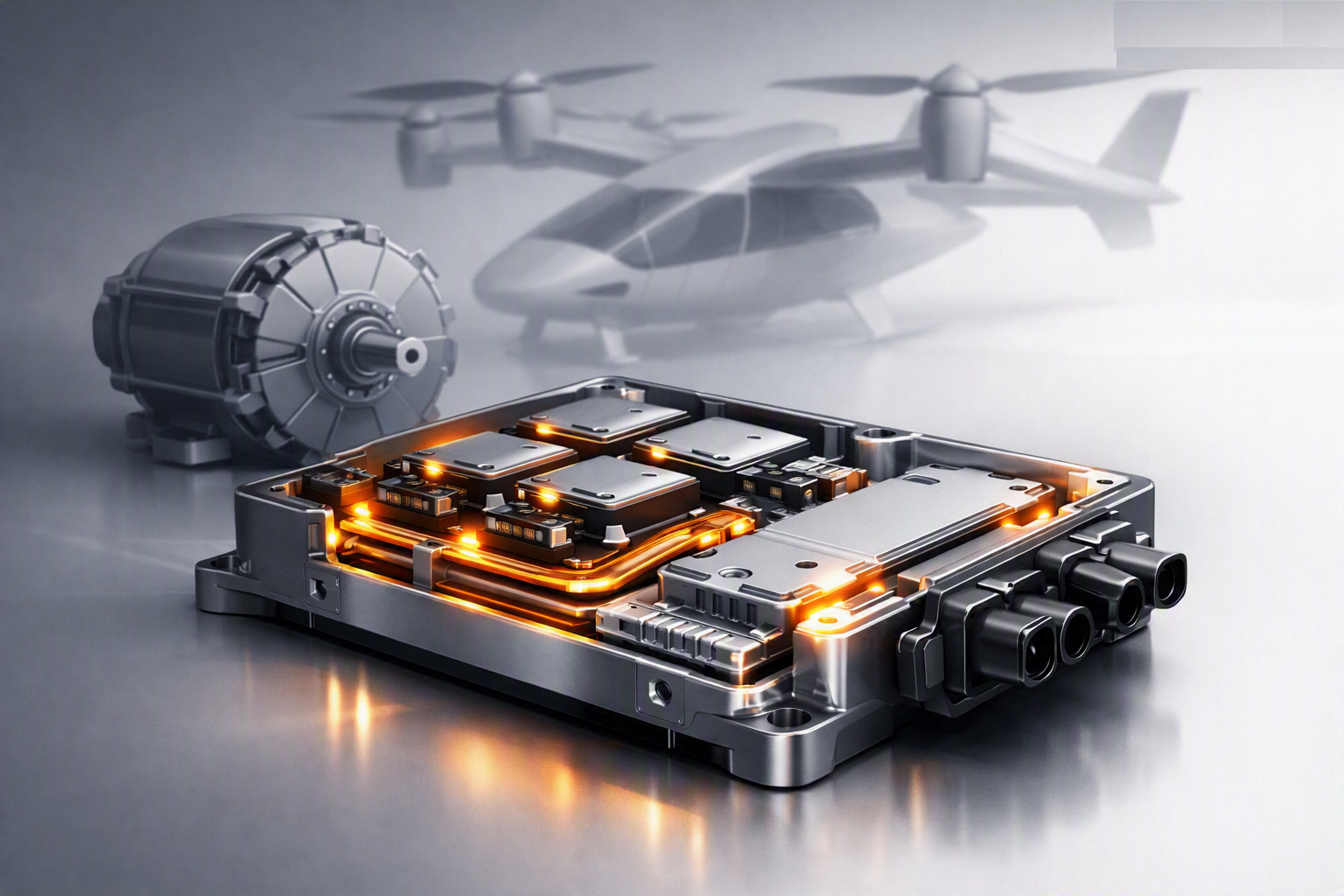
The Daher, Safran and Airbus EcoPulse campaign brought a turbogenerator and an Airbus high-voltage battery together in a flying demonstrator. The partners describe a Power Distribution and Rectification Unit that protects the network and distributes electrical power. They report an 800 V battery capable of supplying up to 350 kW.
Those are useful hardware and integration references. They do not reveal a complete power-sharing schedule, establish commercial-aircraft certification or make the illustrative 300/200 kW example an EcoPulse operating point.
PropulsionWatch analysis: Reducing generator size can increase dependence on battery support. Increasing it changes installed mass, fuel use and cooling requirements. A credible trade therefore needs mission durations and component maps, not only peak ratings.
The same logic applies after a source failure. A battery intended for brief peak support may face a different duration if the generator is lost; loss of battery support changes available peak power. Shared distribution, cooling and controls also need assessment. Multiple energy sources do not, by themselves, prove independent propulsion paths.
The practical evidence is a power-and-energy budget covering normal and relevant degraded missions, together with validated transient response and control limits. Related Systems articles explain redundancy beyond rotor count, power electronics and mission-level heat rejection.
Scope: Generic engineering explanation. Worked values and diagrams are original illustrations, not aircraft specifications, a proposed certified design or an operational control schedule.