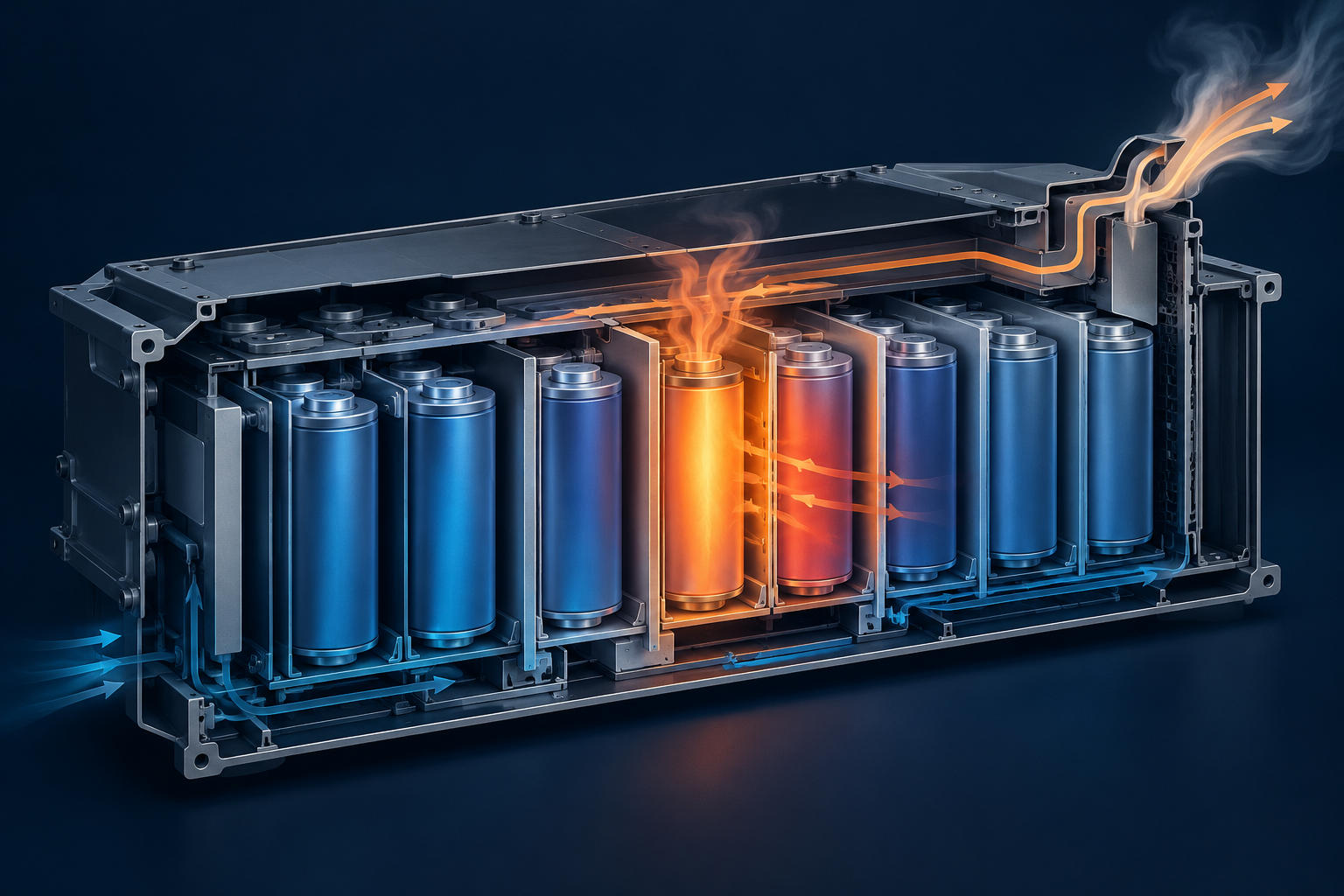
High-voltage DC distribution reduces current for a given propulsion power, but different faults demand different protection. A low-impedance short, a high-impedance fault and a series arc do not present the same electrical signature, and DC fault clearing lacks the natural current zero available in AC systems.
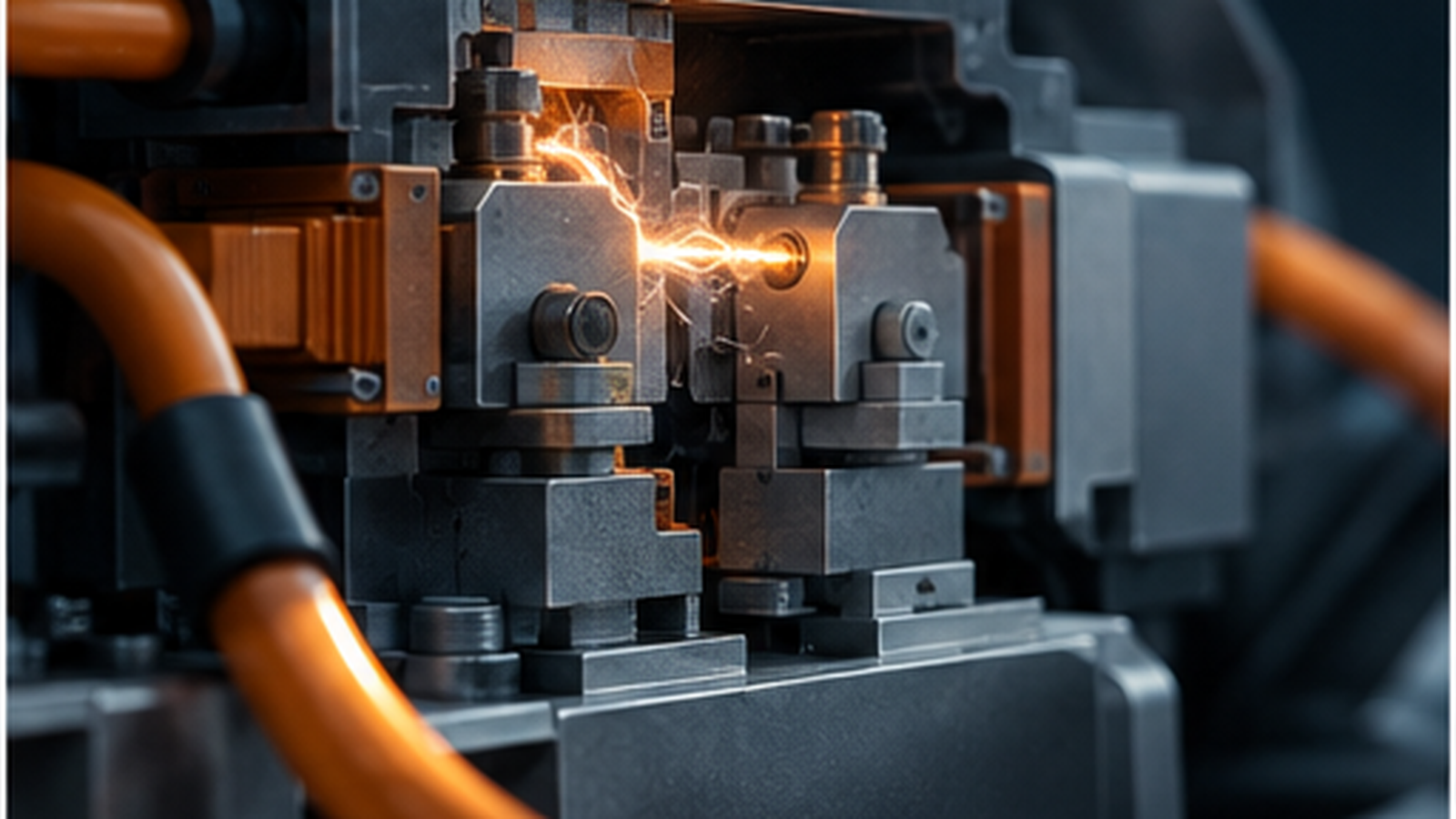
1.2 kV / 1 kA — NASA/RTX experimental DC-breaker operating point 1.2 MVA — reported prototype rating ~5× — specific-power improvement reported relative to the study's stated commercial baseline
High-voltage propulsion distribution needs protection that can distinguish and clear very different fault types without unnecessarily removing healthy thrust. Series arcs are particularly difficult because normal load current can continue while damage develops.
Representative clearing-time data, aged-wire and connector arc testing, fault coordination across segmented buses, and evidence showing how much propulsion remains after realistic high- and low-impedance electrical faults.
A bolted short circuit is the fault that conventional overcurrent protection is best prepared to notice: current rises rapidly and the system has to isolate the damaged section before conductors, semiconductor switches or batteries exceed their safe limits. A series arc is more awkward. It can develop at a damaged connection while load current remains too low to trip conventional overcurrent protection.
That difference matters in high-voltage electric aircraft because propulsion power is routed through batteries, contactors, busbars, cables, inverters and multiple motor branches. Higher distribution voltage can reduce conductor current and mass for a given power level, but it also makes insulation coordination, arc behavior and DC interruption more demanding, placing more responsibility on detection and isolation.
A low-impedance line-to-line or line-to-ground fault can produce a large current transient. Protection can use current magnitude, rate of rise, differential measurements or other signatures to identify the event. The challenge is clearing it quickly enough while avoiding nuisance trips during legitimate propulsion transients.
High-impedance faults are harder because the fault path limits current. A damaged conductor touching a resistive structure or contaminated surface may produce less obvious overcurrent while still creating heating, arcing or hazardous touch potential. Detection then needs more than one threshold applied to total bus current.
Series arcs are different again. A loose or partially separated conductor can force current through an arc in series with the normal load. Because the load itself limits current, the event can hide inside the expected current envelope. NASA research on DC series-arc detection focuses on separating the arc's electrical signature from inverter and converter switching noise.
Alternating current crosses zero every half-cycle. That natural zero can help extinguish an arc when a protective device opens. A DC system has no equivalent periodic current zero, so a breaker or contactor has to force current down and manage the stored electromagnetic energy itself.
Aircraft weight makes the job harder. A protection device can always be made more robust by adding larger contacts, arc-control structures, heat capacity and insulation, but those additions compete with payload and range. Solid-state interruption can operate quickly and without mechanical contact separation, yet conducting semiconductor devices can impose continuous loss and thermal-management requirements.
Hybrid breakers combine mechanical and semiconductor elements to trade steady-state efficiency against interruption speed. The optimum depends on bus voltage, prospective fault current, required clearing time, coordination with other protective devices and acceptable failure modes.
NASA reported work with RTX on an experimental 1.2 MVA DC circuit breaker for electrified-aircraft power distribution, including a 1.2 kV / 1 kA operating point. The report describes roughly a fivefold specific-power improvement relative to the commercial baseline used in that study.
Those numbers are research-hardware data, not evidence that a production eVTOL uses a 1.2 kV bus or that this breaker is certificated for passenger service. They are useful because they expose a systems constraint: megawatt-class electrified aircraft need protection hardware that can interrupt substantial DC power without becoming a prohibitive mass or cooling penalty.
The protection mass belongs in propulsion architecture comparisons just as motor, inverter and cable mass do. A high-voltage design that saves copper but requires heavier switching, insulation and arc-control hardware may recover less aircraft mass than the conductor calculation suggests.
Distributed propulsion creates an additional requirement: isolate a failed branch without unnecessarily removing healthy thrust. A common bus fault may have a different aircraft consequence from a motor-feeder fault. Protection zones, bus segmentation and power-source isolation therefore interact with the redundancy architecture.
PropulsionWatch's distributed-propulsion redundancy analysis makes the same point from the thrust side. Multiple motors do not create meaningful redundancy if a common electrical fault can remove several channels at once.
Coordination is also dynamic. A breaker fast enough to protect semiconductor switches must distinguish a true fault from the high current demanded by a rapid torque command. A battery pack may have its own contactors and current limits. Inverters contain DC-link capacitors that can discharge locally even after upstream isolation. Fault energy therefore depends on the network state at the instant of failure.
Series arcs can generate broadband and high-frequency electrical features, but modern motor drives also switch rapidly and inject deterministic and stochastic noise into the bus. A detector tuned too aggressively risks false positives; one tuned too loosely may miss a developing fault.
NASA's system-agnostic arc-fault work is aimed at this distinction. The research is important because aviation systems cannot rely on a detector that works only with one laboratory load. Propulsion commands, converter operating points and cable impedances change during flight, so the diagnostic has to remain robust across legitimate system states.
Altitude and insulation condition can further affect arc behavior. That links protection back to the high-voltage insulation problem: fault prevention and fault clearing are separate layers of the same propulsion safety architecture.
Detecting a fault is only the first event in a chain. The system must isolate it, contain any resulting arc or thermal damage, preserve required aircraft functions and prevent an unsafe re-energization. It also has to communicate the degraded state to flight control and the crew or automation.
NASA has been testing high- and low-impedance fault cases in electric-aircraft HVDC systems. That kind of verification is more informative than a component's interruption rating alone because it tests the protection logic against network behavior.
For production AAM aircraft, useful public evidence would include bus segmentation philosophy, representative clearing times, residual propulsion capability after electrical faults and testing that covers aged connectors or wiring rather than only ideal shorts. The important number is not simply bus voltage. It is how much fault energy can reach a damaged location before the architecture detects, isolates and safely reconfigures around it.
NASA NTRS — 1.2 MVA DC circuit breaker for electrified aircraft
NASA NTRS — System-Agnostic Process to Design DC Series Arc Fault Detectors
NASA NTRS — high- and low-impedance HVDC fault verification testing