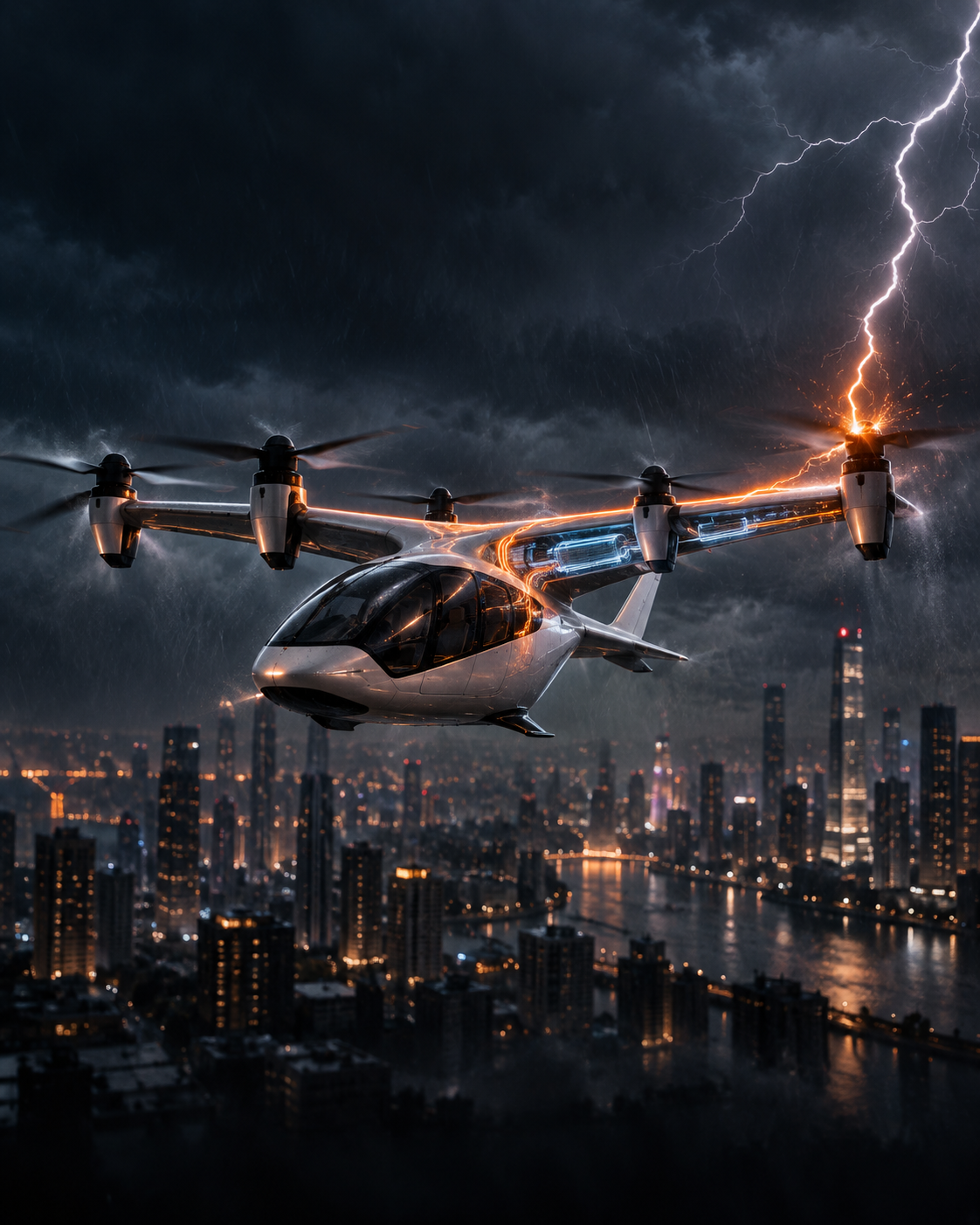
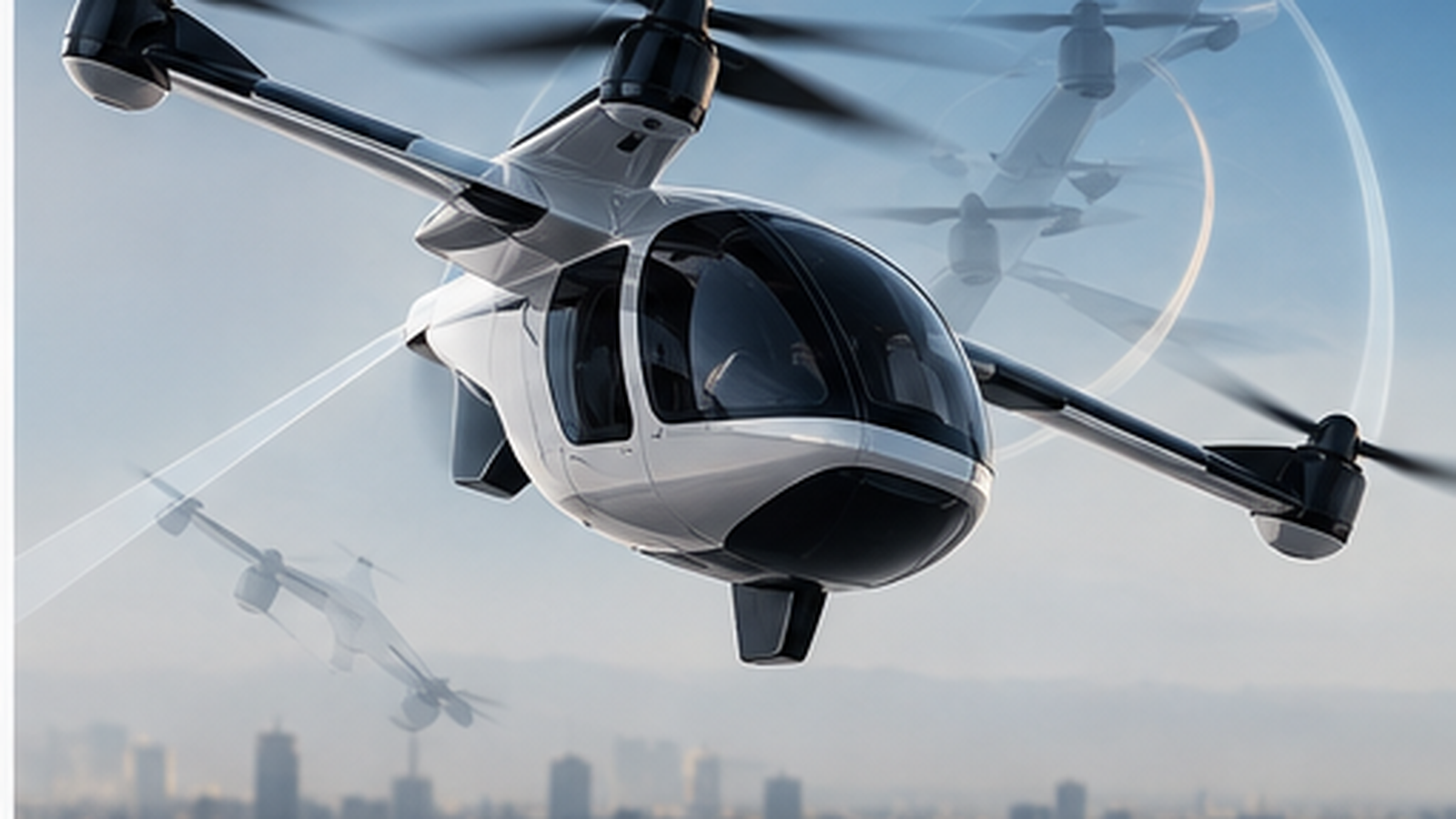
An electric motor can be quiet while its rotor is not. eVTOL community noise is shaped by blade-passing tones, tip speed, aerodynamic loading, broadband turbulence and interactions between multiple rotors and the airframe, making acoustics a propulsion-system design variable rather than a motor-noise problem.
fBPF = blades × RPM / 60 — blade-passing frequency 5 blades at 1,200 rpm = 100 Hz — illustrative fundamental blade-passing tone 2026 — NASA published tip-speed sweep data separating periodic and broadband rotor noise
Electric propulsion removes combustion-engine noise but not aerodynamic rotor noise. RPM, tip speed, blade loading, rotor interaction and installation determine the community acoustic signature and can constrain efficiency, control strategy and aircraft geometry.
Full-aircraft spectra through transition, rotor-phase and RPM scheduling evidence, installation effects at representative scale, and repeatable community-noise measurements tied to exact flight condition and observer geometry.
For a rotor with N blades turning at a rotational speed in revolutions per minute, the fundamental blade-passing frequency is fBPF = N × RPM / 60. A five-bladed rotor at 1,200 rpm therefore has a 100 Hz blade-passing fundamental, with harmonics above it. The example is generic, but the equation explains why changing rotor speed changes not only overall sound level but where prominent tones sit in the spectrum.
That matters for eVTOLs because replacing a combustion engine with an electric motor removes major engine-noise sources without removing aerodynamic noise from the propulsor. In hover and transition, blades still accelerate air, shed vortices and interact with wakes. A distributed aircraft can multiply those interactions across several rotors.
Rotor sound is commonly separated into periodic, or tonal, content and broadband content. Periodic loading repeats once per revolution or blade passage and concentrates acoustic energy at discrete frequencies. Broadband noise is spread over a wider spectrum and can arise from turbulent inflow, boundary layers and blade–wake interaction.
The distinction matters because two propulsion systems with a similar overall sound-pressure level can sound different to a listener. Strong tonal components are perceptually prominent, while broadband content can dominate elsewhere in the spectrum. Community-noise assessment therefore cannot be reduced to one motor dB value measured on a bench.
NASA's Revolutionary Vertical Lift Technology work includes acoustic testing of advanced rotors and propellers specifically because the source mechanisms depend on the installed aerodynamic environment. The program has examined pusher-propeller installations, multirotor testbeds and rotor–rotor / rotor–airframe interactions.
Blade-tip speed combines rotational speed and rotor radius. It is often expressed through tip Mach number, approximately Mtip = ΩR/a, where Ω is angular speed, R is radius and a is the speed of sound. Forward flight adds an asymmetric inflow that makes the local blade velocity more complicated than the hover expression, but the basic relationship remains useful.
Higher tip speed can allow a rotor to produce required thrust with different blade loading or size, but it can increase compressibility effects and shift blade-passing tones upward in frequency. Reducing RPM can help acoustics in some conditions, yet maintaining thrust may require more blade pitch, more disk area or higher loading, each with efficiency and structural consequences.
A 2026 NASA technical memorandum studied varying tip speeds and separated periodic and broadband acoustic effects. The result is important less as a universal optimum than as evidence that RPM is an acoustic control variable with measurable spectral consequences.
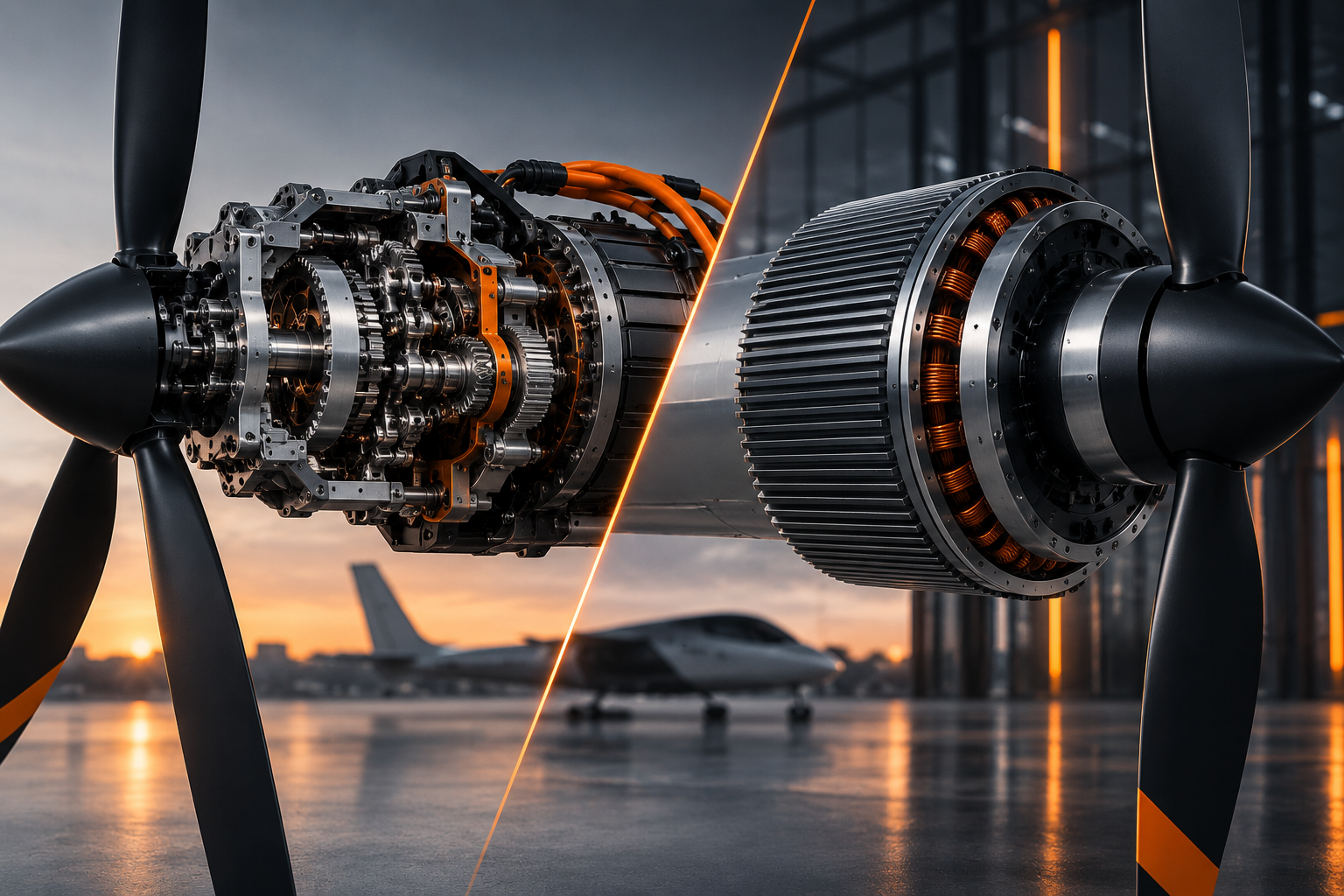
This trade connects directly to geared versus direct-drive propulsion. A gearbox can let the motor and propeller operate at different speeds, but installed mass, mechanical loss, durability and noise all enter the same aircraft-level choice.
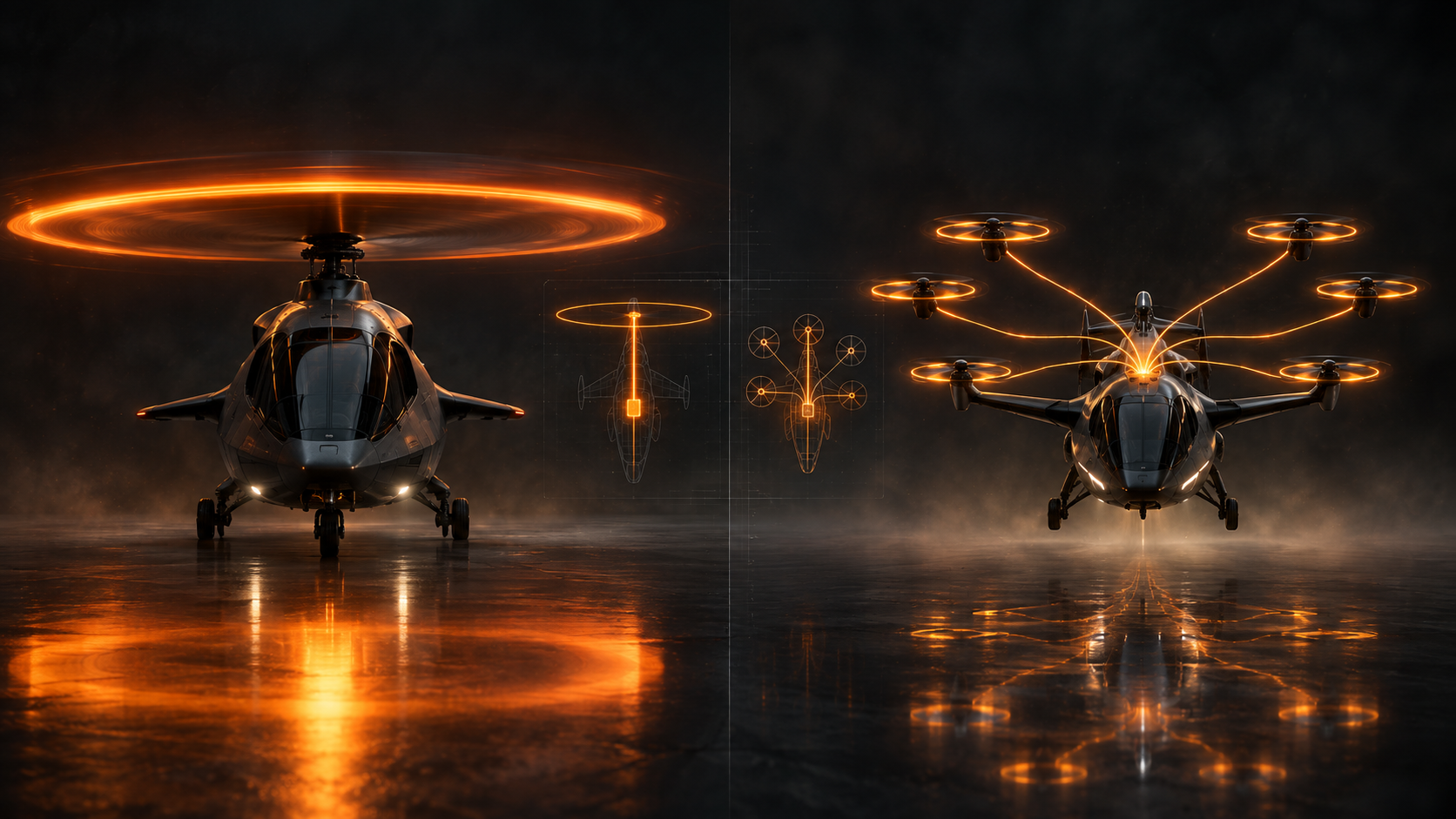
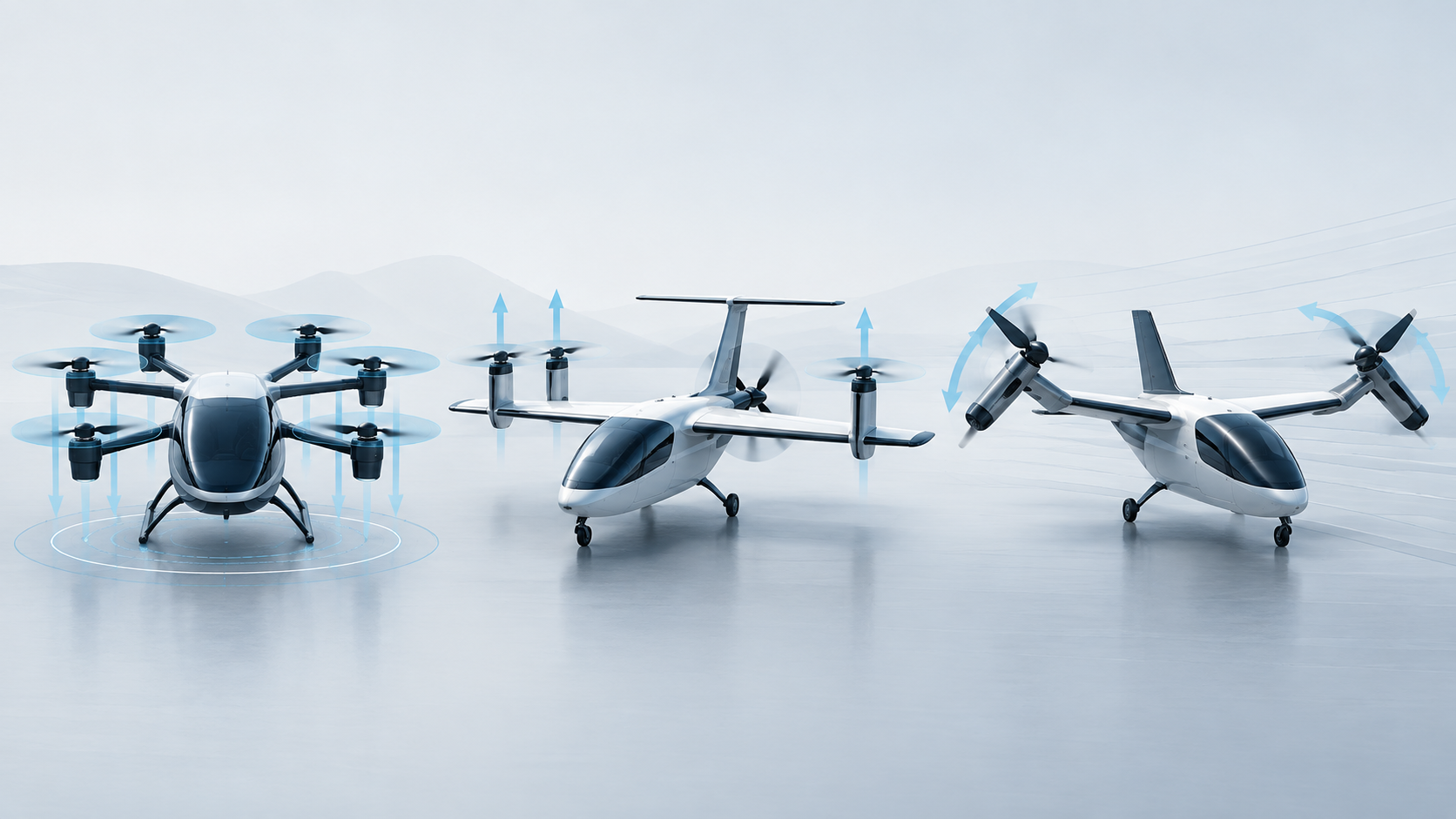
Distributed electric propulsion introduces source combinations that are less important on a conventional single-propeller aircraft. One rotor can ingest the wake or tip vortex of another. A tilting propulsor can move through highly non-uniform inflow during transition. Blades can pass near wings, booms or fuselage surfaces and generate unsteady loading.
Those interactions can create additional tones or amplitude modulation even if each isolated rotor tests well. Relative rotor phase can matter when coherent acoustic fields combine. In principle, control laws can exploit speed or phase scheduling to alter the acoustic signature, but the aircraft still has to preserve thrust, stability margins, motor limits and failure tolerance.
The implication is not that more rotors are necessarily louder. Distribution can reduce loading per rotor and create useful control authority. The defensible conclusion is narrower: the acoustic output of a many-rotor aircraft cannot be inferred by multiplying the isolated noise of one propulsor.
Airframe surfaces can scatter or shield sound. They can also disturb inflow and create unsteady blade loading. A pusher propeller behind a wing or fuselage encounters a different flow field from an isolated propeller in a static test stand. A lift rotor near a boom or another rotor has its own interaction geometry.
This is why NASA's current full-scale eVTOL acoustic work is valuable. TechPort project 154389 targets aerodynamic and acoustic flight-test data for rotor–rotor and rotor–airframe interactions, helping validate methods that otherwise depend heavily on smaller-scale or simplified configurations.
Scale matters acoustically. Reynolds number, tip Mach number, installation geometry and observer distance all complicate direct transfer from a small rotor rig to a full aircraft. High-quality full-scale data are therefore an evidence bottleneck, particularly through transition where flow and control state change rapidly.
A rotor optimized only for low acoustic output at one operating point would not define an aircraft propulsion system. eVTOLs need hover efficiency, forward-flight performance, acceptable structural loads, manageable diameter, ground clearance and robust control across the envelope.
Variable RPM can move tonal content and reduce tip speed, but the motor and inverter need enough transient torque to make those changes. Larger rotors lower disk loading but enlarge the aircraft footprint. More blades can shift loading and frequency content but add blade mass, hub complexity and wetted area.
Operational procedures add another variable. Flight path, climb gradient, speed and rotor schedule determine where and when sound is generated relative to communities. That turns acoustic design into a joint propulsion, flight-control and operations problem rather than a final-stage noise treatment.
Headline statements such as “quieter than a helicopter” are difficult to interpret without measurement geometry, flight condition and frequency information. Better evidence would publish spectra and observer locations for hover, climb, transition, cruise and approach, along with vehicle configuration and atmospheric conditions.
The propulsion question is then visible in the data: which tones track RPM, which broadband components rise with loading, and which features appear only when rotors interact with each other or the airframe. Full-scale repeated measurements will show whether laboratory acoustic advantages survive the installed aircraft and its control schedule.
NASA RVLT — technical highlights
NASA NTRS — Aerodynamic Performance and Acoustic Impacts of Varying Tip Speeds
NASA TechPort — full-scale eVTOL aerodynamic and acoustic flight-test validation