A battery can retain charge yet lack the power needed for a demanding landing segment. Voltage, current, temperature, ageing and demand duration determine usable landing capability; a reserve percentage alone cannot describe it.

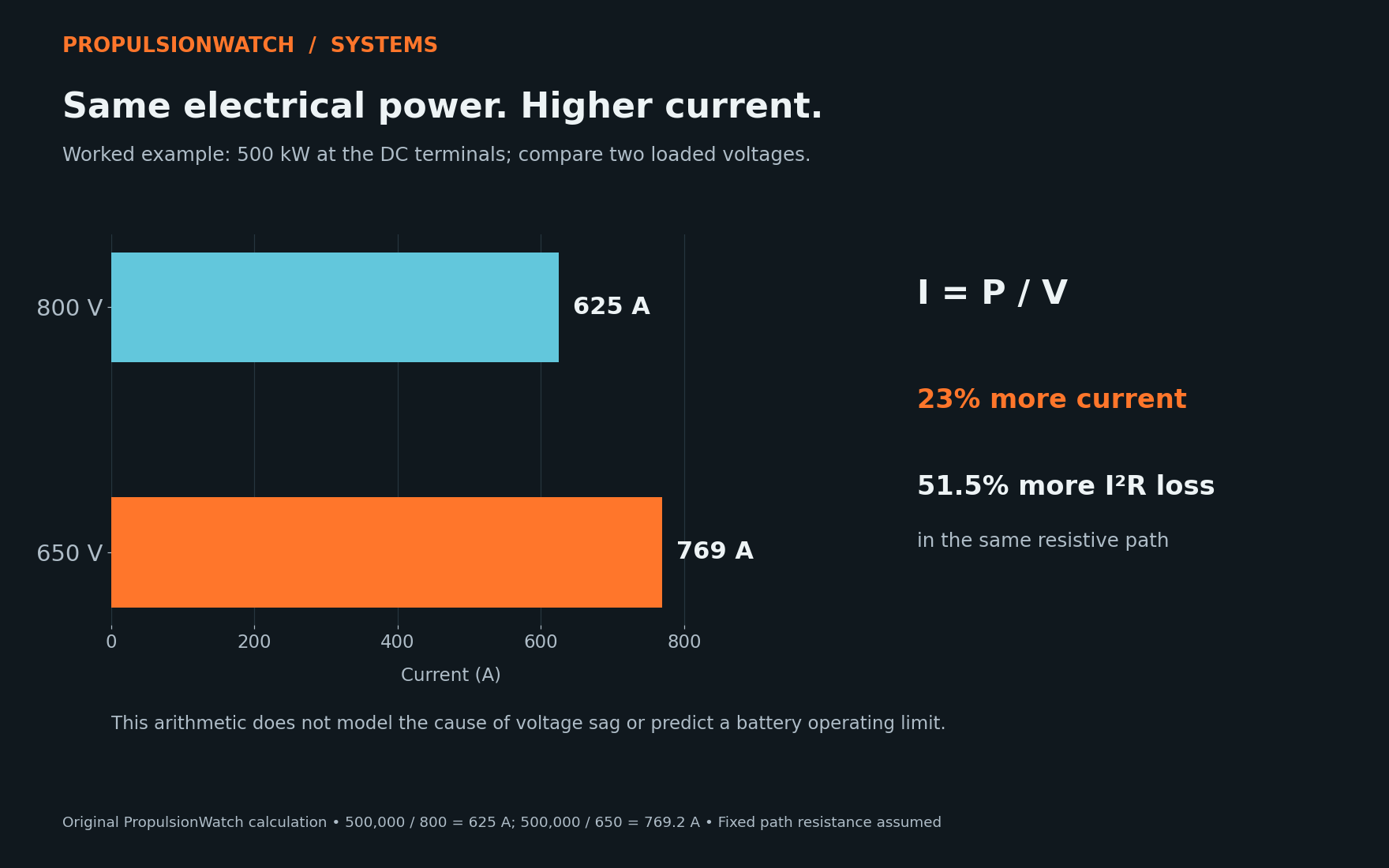
500 kW — illustrative electrical demand in the worked example 625 A / 769 A — current at 800 V / 650 V respectively 51.5% — calculated increase in I²R loss in the same resistive path; not total battery heat
Landing capability depends on whether the battery can deliver the required power for the required time, as well as retain sufficient energy.
Landing-duration tests across temperature and ageing, uncertainty in battery-state estimates, and aircraft-level validation of usable power and energy.
An eVTOL can finish cruise with charge remaining and still face a difficult electrical demand at landing. For an aircraft returning to powered lift, the propulsion system may need high power just when battery voltage and remaining energy are lower than at departure. A percentage on a display does not describe that complete operating condition.
The engineering question has two parts: is there enough usable energy to complete the intended profile, and can the battery supply each required power level for long enough? Both must be answered for the aircraft configuration and conditions being assessed.
State of charge estimates the fraction of charge remaining relative to a defined reference capacity. Energy, measured in kWh, also depends on voltage during discharge. Power, measured in kW, describes the rate of energy delivery. A power-capability estimate therefore needs a duration: a short pulse and a sustained landing segment are different demands.
NASA's parametric battery study shows why treating a pack as fixed specific energy plus fixed specific power can misrepresent late-mission capability. Its model follows voltage and current through the mission and includes the power needed for a balked landing. The resulting usable charge depends on the selected assumptions, rather than a universal lower state-of-charge threshold.
At the DC terminals, P = VI. If a load needs the same electrical power at a lower voltage, it draws more current. Battery voltage under load depends on charge state and electrochemical behaviour; component current limits can therefore become active before the battery is empty.
Consider an illustrative 500 kW electrical load. At 800 V it draws 625 A. At 650 V it draws about 769 A, roughly 23% more. In a cable or other path with unchanged resistance, resistive loss scales with I²R: the second case produces about 51.5% more loss in that same path.
The example also explains the importance of measurement boundaries. Battery-terminal power is not motor-shaft power: downstream conversion and wiring losses must be supplied too. NASA's X-57 battery-profile work cautions against using nominal cell metrics and fixed efficiency across an aircraft mission. Its numerical efficiencies belong to the studied configurations and profiles.
Hatherall and colleagues at Warwick tested the lowest charge state at which cells could complete a specified constant-power pulse. They varied temperature, pulse power and duration, and compared differently aged cells. Their resulting maps connect those conditions to the ability to finish the pulse.
The useful lesson is the test structure, not a percentage to copy into a flight plan. It examines a complete power demand at low charge. The published cell results do not account for every pack, cooling installation or aircraft mission. Capacity-based battery-life criteria also cannot, by themselves, establish landing-power capability.
NASA-hosted battery monitoring and prognostics research combines battery models with real-time state estimation and propulsion monitoring. Its demonstrations include a small octocopter flight case and an aircraft simulation. That is research evidence for the approach, not validation of a passenger-aircraft dispatch system.
For a capability prediction to be useful, the model must represent the demand still to come. A low-power continuation followed by a high-power landing cannot be assessed solely by dividing remaining nominal energy by today's cruise power. Estimation uncertainty matters too: voltage and temperature measurements support a model, rather than directly revealing every internal battery state.
PropulsionWatch analysis: A meaningful landing-reserve claim should state the power boundary, demand duration, initial thermal condition, battery ageing condition and applicable voltage/current limits. It should show how the remaining mission and defined contingencies fit inside that envelope, including uncertainty and the aircraft's relevant degraded configurations.
This adds a mission-capability question to the site's existing explainers on cell energy and pack mass, battery life and thermal management. No single reserve percentage follows from the studies cited here; aircraft-specific approved data and procedures determine operational limits.
Scope: Research synthesis and first-principles illustration. Diagrams are original PropulsionWatch work. They do not reproduce proprietary aircraft limits or provide flight-planning instructions.