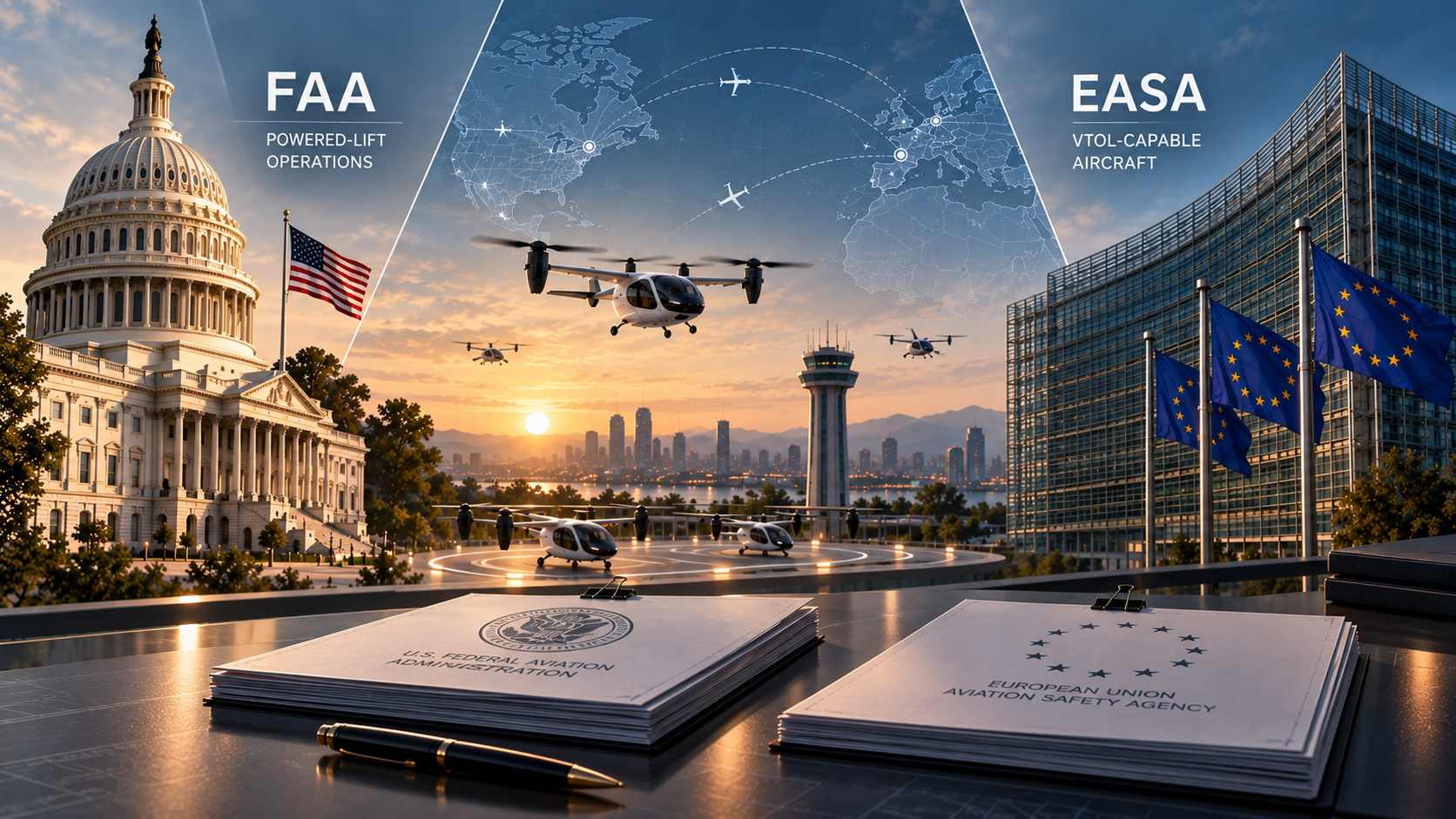
Eve and EHang show why eVTOL certification cannot be read through an FAA-only lens. Eve is pursuing a multi-authority validation strategy led by Brazil's ANAC, while EHang has already received Chinese design and production approvals for the materially different pilotless EH216-S.

February 2022 — Eve formalized its Type Certificate application with Brazil's ANAC August 18, 2026 — comment period closes on ANAC's updated Eve 100 airworthiness criteria April 2024 — EHang's EH216-S received the world's first eVTOL Production Certificate (CAAC)
Eve and EHang show why certification has to be read jurisdiction by jurisdiction. Eve is pursuing ANAC-led certification with international validation, while EHang's CAAC approvals apply to a materially different pilotless aircraft and operating concept.
For Eve, watch ANAC certification progress and how much work FAA/EASA validation can reuse. For EHang, watch scaling under CAAC approvals and any attempt to validate the aircraft or derivatives in materially different regulatory systems.
eVTOL certification is developing through several national systems, and the resulting approvals are not automatically interchangeable. Eve Air Mobility is building its certification strategy around Brazil's ANAC with validation in additional markets; EHang's EH216-S has already received approvals from China's CAAC. The two programs illustrate different regulatory paths rather than a common race.
Eve formalized its type-certificate application with ANAC in 2022. ANAC published final airworthiness criteria in 2024 and opened consultation on updated criteria in July 2026 as part of harmonization work. Eve has also pursued FAA validation and applied in July 2026 to begin EASA validation. The important distinction is between primary type certification and validation: another authority may leverage the certifying authority's findings, but it still determines whether the foreign approval satisfies its own requirements and any identified differences.
Eve describes its approach as globally coordinated. That is strategically relevant, but the degree of portability will depend on authority-to-authority agreements, aligned certification bases and accepted means of compliance, not simply on filing applications in several jurisdictions.
The EH216-S has received a CAAC Type Certificate and Production Certificate, with individual standard airworthiness certificates and operator approvals also issued for commercial human-carrying services. These are substantive regulatory milestones. They demonstrate approval of a pilotless passenger-carrying eVTOL design and its production system within the Chinese framework.
They do not establish a like-for-like precedent for piloted powered-lift aircraft being developed for FAA or EASA operations. EH216-S differs in architecture, range, pilot model, operating concept, regulator and certification basis. Statements that it is “ahead” of a US or European program therefore need those differences attached.
The industry-level question is how much compliance evidence can be reused across authorities. Repeating every test and analysis would add time and cost; accepting findings without resolving regulatory differences would undermine the purpose of validation. Bilateral arrangements and harmonization work are intended to occupy the middle ground.
For Eve, the evidence to watch is completion of transition testing, conforming-aircraft production and ANAC compliance findings, plus the extent to which FAA and EASA validations can reuse that work. For EHang, the relevant evidence is how CAAC-approved operations scale and whether the aircraft or derivatives pursue validation in materially different regulatory systems.
Not investment advice. Regulatory approvals are described within their own jurisdiction and operating context.