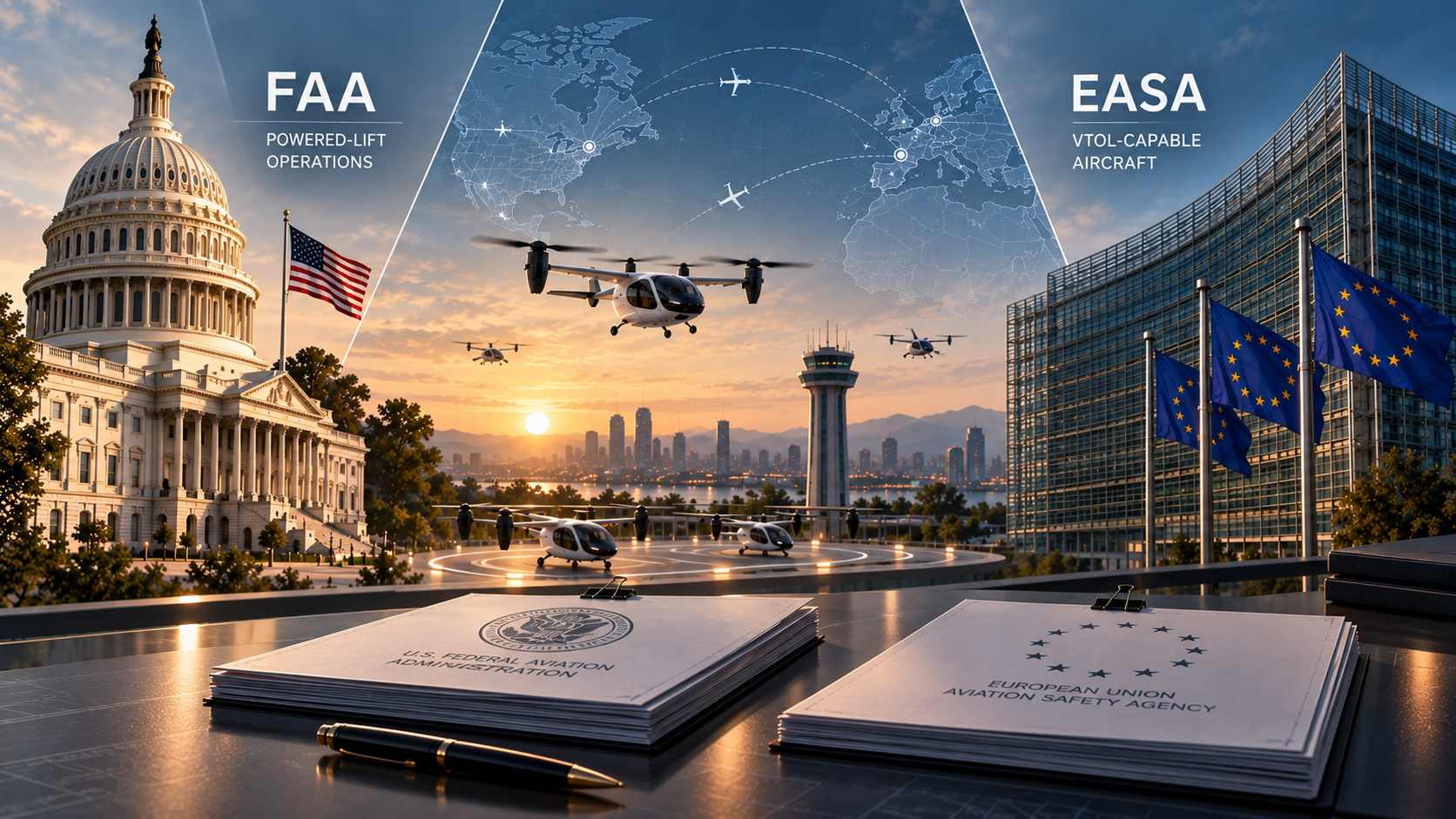
FAA and EASA eVTOL certification is not a single checklist. Each program needs an approved certification basis, means of compliance, conformity evidence and testing, followed by separate production and operational approvals before routine passenger service.

10⁻⁹ — EASA Enhanced-category catastrophic-failure probability objective commonly expressed at aircraft/system safety level 0 — FAA-issued type certificates for piloted passenger eVTOL/powered-lift aircraft as of this article's update
“Certified” can refer to different approvals. Type design, production, individual-aircraft airworthiness, pilot qualification and operating authority are separate regulatory scopes, so a test flight or certification-stage milestone is not the commercial finish line.
Accepted compliance findings, conformity testing, completed certification tests, issued type and production approvals, and the validation work required when aircraft move between jurisdictions.
“Certified” is too broad a word for an aircraft program. Type certification approves a design against an applicable certification basis; production approval addresses repeatable manufacture; individual airworthiness and operating approvals address different scopes again. Reading eVTOL progress accurately starts by identifying which approval is actually being discussed.
The FAA uses the powered-lift category for aircraft that combine vertical-lift and airplane-like flight characteristics. Type certification proceeds under 14 CFR Part 21, with applicable airworthiness criteria established for the particular design. Operational and pilot-qualification rules are separate from the type-design approval.
The process is iterative. Applicant and regulator establish the certification basis and means of compliance; conformity is controlled so test articles represent the design being substantiated; analysis, ground testing and flight testing then generate compliance evidence. A prototype flight, even a piloted one, is therefore not equivalent to type certification.
EASA's SC-VTOL provides the special-condition framework for VTOL aircraft. Its Basic and Enhanced categories use different safety objectives and operating assumptions. Enhanced-category designs face particularly stringent catastrophic-failure objectives, but quoting a numerical probability target without its system-safety context can be misleading: compliance is demonstrated through an integrated safety process, architecture, analysis and verification rather than by measuring billions of flight hours.
The authorities have worked to align aspects of powered-lift/eVTOL certification, which can reduce duplicated effort when an aircraft seeks validation in another jurisdiction. Alignment should not be described as one shared rulebook. Differences in certification basis, acceptable means of compliance and administrative process can remain and have to be resolved through validation.
After design approval, a manufacturer still has to demonstrate control of production and each aircraft must receive the appropriate airworthiness documentation. Operators, pilots, maintenance systems, infrastructure and operating approvals introduce additional requirements. The sequence varies with jurisdiction and operating concept.
That is why schedule claims deserve careful wording. A developer can report substantial certification progress without having a regulator-approved commercial-service date. The strongest evidence is not a percentage-complete graphic but accepted compliance findings, conformity testing, completed certification tests and issued approvals.
For company-specific progress, see the PropulsionWatch certification tracker.