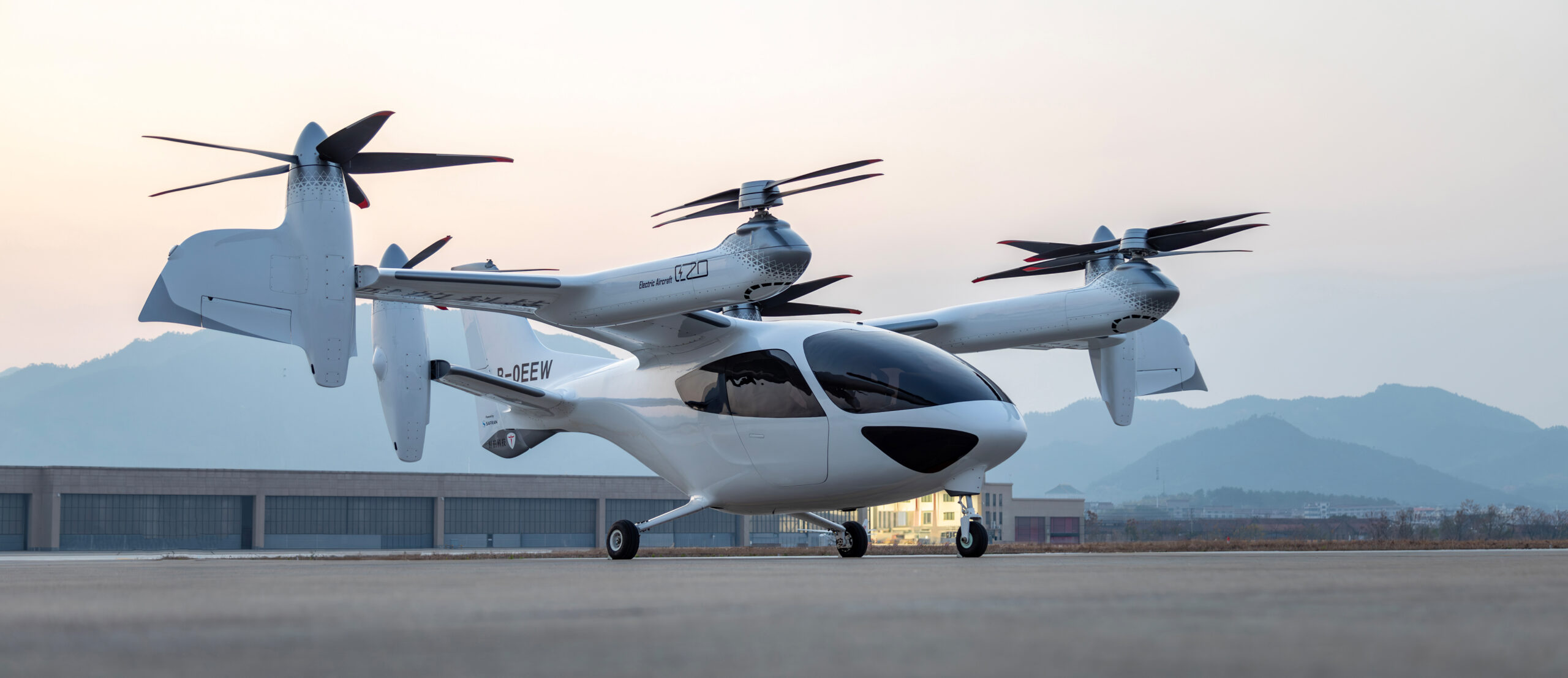
Piloted battery-electric tilt-rotor eVTOL using large, low-speed five-blade propellers and wing-borne cruise.
Propulsion Unit Count
Redundancy Approach
Company reports heterogeneous redundant flight controls, distributed propulsion and four independent battery packs; certification-level evidence is not public.
Range / Speed
Manufacturer-published: 200 km maximum range, 320 km/h maximum speed and 450 kg payload; not certified performance.
Seat Count
5
Last Updated
September 25, 2026
E20 remains in active CAAC type certification. TCab reports that the G-1 certification basis was issued in December 2024, G-2 means of compliance was issued in April 2026 and certification plans were accepted in June 2026. The full-scale demonstrator completed transition-flight testing in December 2025. No Type Certificate has been identified.
Execute the accepted certification plans and complete conformity, CAAC compliance demonstrations and findings on the certification configuration.
E20 is a five-seat piloted tilt-rotor eVTOL for intercity and urban missions. The aircraft uses vertical thrust for takeoff and tilts its propulsors for wing-borne cruise.
The program remains certification-stage and PRE-EIS. Piloted tests and a permit to fly support development but do not authorize passenger service.
TCab publishes a fully electric architecture, five seats, 450 kg payload, 200 km range and 320 km/h maximum speed. It also describes large low-speed five-blade propellers, four independent battery packs and distributed propulsion.
The final propulsion-unit count and detailed failure-containment design were not stated clearly enough in reviewed primary material to populate as verified configuration.
CAAC accepted the E20 Type Certificate application in October 2023. TCab reports that the Type Certification Team held its first review and the Aircraft Evaluation Group review began in December 2024, when the G-1 certification basis was also issued.
The company reported a manned flight test in October 2025 and completion of transition-flight testing on 3 December 2025. Its current program history states that G-2 means of compliance was issued in April 2026 and certification plans were accepted in June 2026. These are substantive certification-process milestones, but none is Type Certificate issuance.
TCab markets E20 for low-altitude tourism, intercity air mobility and urban transport. Orders, partnerships and demonstration flights are commercial-development evidence, not approved public service.
Remaining dependencies include conformity, transition-envelope demonstration, propulsion and battery qualification, continued safe flight-test expansion, CAAC findings of compliance, production approval and operating approvals.
TCab program history — reviewed 19 Sep 2026: TC application acceptance, G-1, G-2 and certification-plan milestones. Source.
Manufacturer transition-flight update — 3 Dec 2025: full-scale E20 demonstrator completed transition-flight testing, including validation across the tilt corridor and representative sensor/actuator environments. Source.
Manufacturer technical page — reviewed 19 Sep 2026: current E20 configuration and certification progress. Source.
Evidence boundary: G-1, G-2, accepted certification plans and flight tests are certification-progress evidence, not a Type Certificate or passenger-service approval.
September 25, 2026