Hybrid-electric tilt-wing: four main electric propellers on one tilting wing plus a smaller auxiliary tail thruster. Main-wing and nacelle motion are coupled.
Propulsion Unit Count
5
Redundancy Approach
Distributed propulsion and a historically announced redundant tail drive. Aircraft-level independence, failure cases and approved operating capability are not established by supplier claims.
Range / Speed
Current product table: typical 20 kg / 200 km mission and 125 km/h efficient cruise. Company reports a July 2026 20 kg / 200 km campaign. 38 kg is useful load, not asserted maximum cargo payload. Older 400/1,300 km Aero2 copy is not treated as current validated range.
Seat Count
0
Last Updated
October 19, 2026
Company reports payload/range validation and Baltic BVLOS resupply proof-of-concept flights in 2026. These do not establish unrestricted commercial authorization or completed serial-production readiness.
Demonstrate repeatable route operations, complete series-aircraft industrialization and document the jurisdiction-specific approvals needed for intended operations.
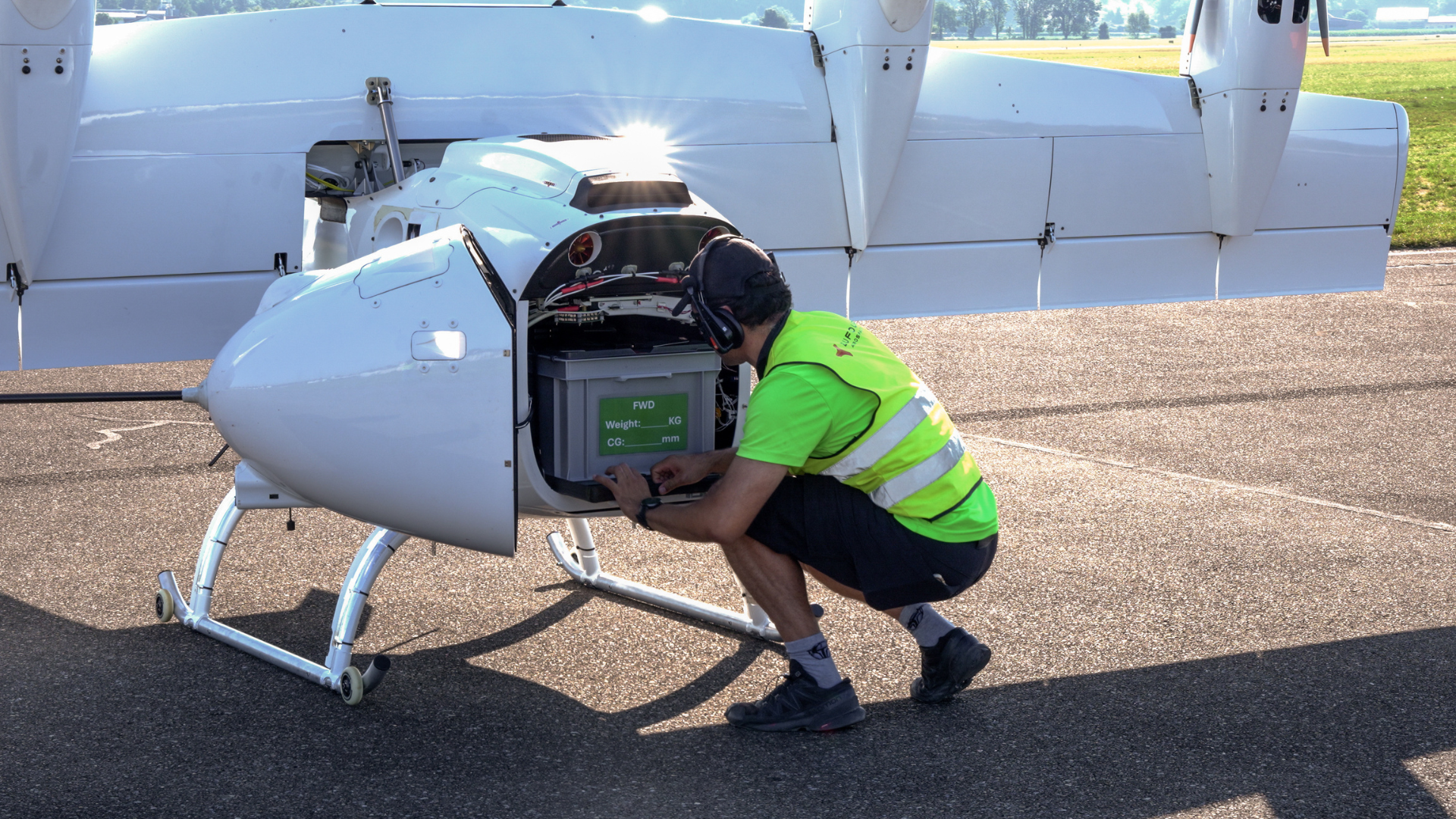
Aero-200 is Dufour's uncrewed hybrid-electric tilt-wing aircraft, previously named Aero2. The exterior combines a single rotating main wing with a front-loaded cargo fuselage, fixed tail surfaces and skid gear.
The current technical table and September 2025 brochure agree on a 6.12 m wingspan and 208 kg maximum takeoff mass. Those are manufacturer-published data, not a regulator-issued performance statement.
Four main electric propellers are attached to the tilting wing. A separate tail-thruster supplier announcement documents an auxiliary electric unit; the 3D view represents its exterior approximately. The structured propulsion count is four main units plus this auxiliary unit.
Dufour describes battery-powered takeoff, with onboard generation powering motors and replenishing batteries during forward flight. The exact battery capacity, installed motor ratings, cooling system and component locations have not been established here.
The 3D Explorer follows public imagery. Only the main-wing span is dimensionally referenced; internal boxes are explicitly functional markers. Wing angle and visible blade speed are explanatory animations.
The manufacturer announced hybrid transition flights in January 2025 and renamed Aero2 to Aero-200 in September 2025. A July 2026 release reports a 20 kg / 200 km trial campaign. The later Baltic update calls the resupply flights operational proof of concept.
Current product material lists 2027 for serial-aircraft availability. This is a company target; older brochure language describing market entry does not establish delivery of production aircraft or unrestricted operations.
The intended roles include critical cargo and sensor missions. Dufour's operating-platform strategy combines aircraft with remote mission execution and fleet supervision. Operational proof-of-concept activity is distinguished from a repeatable, authorized commercial network.
Track reliability across repeated missions, transition and degraded-power performance, remote-control and communications dependencies, industrial readiness and the approval basis for each operation. Multiple propulsion units alone do not prove aircraft-level redundancy.
Current product data supersedes inconsistent legacy Aero2 specification copy for this record. The 38 kg figure is useful load; the payload field below records the 20 kg demonstrated cargo claim and is not a maximum-payload claim. No unverified Type Certificate, battery capacity or motor-unit power is entered.
Primary material reviewed: current product table; September 2025 brochure; renaming announcement; hybrid flight report; 2026 payload/range trials; Baltic proof-of-concept report; tail-thruster selection. Flight results are company-reported; official imagery is credited to Dufour Aerospace.
October 19, 2026