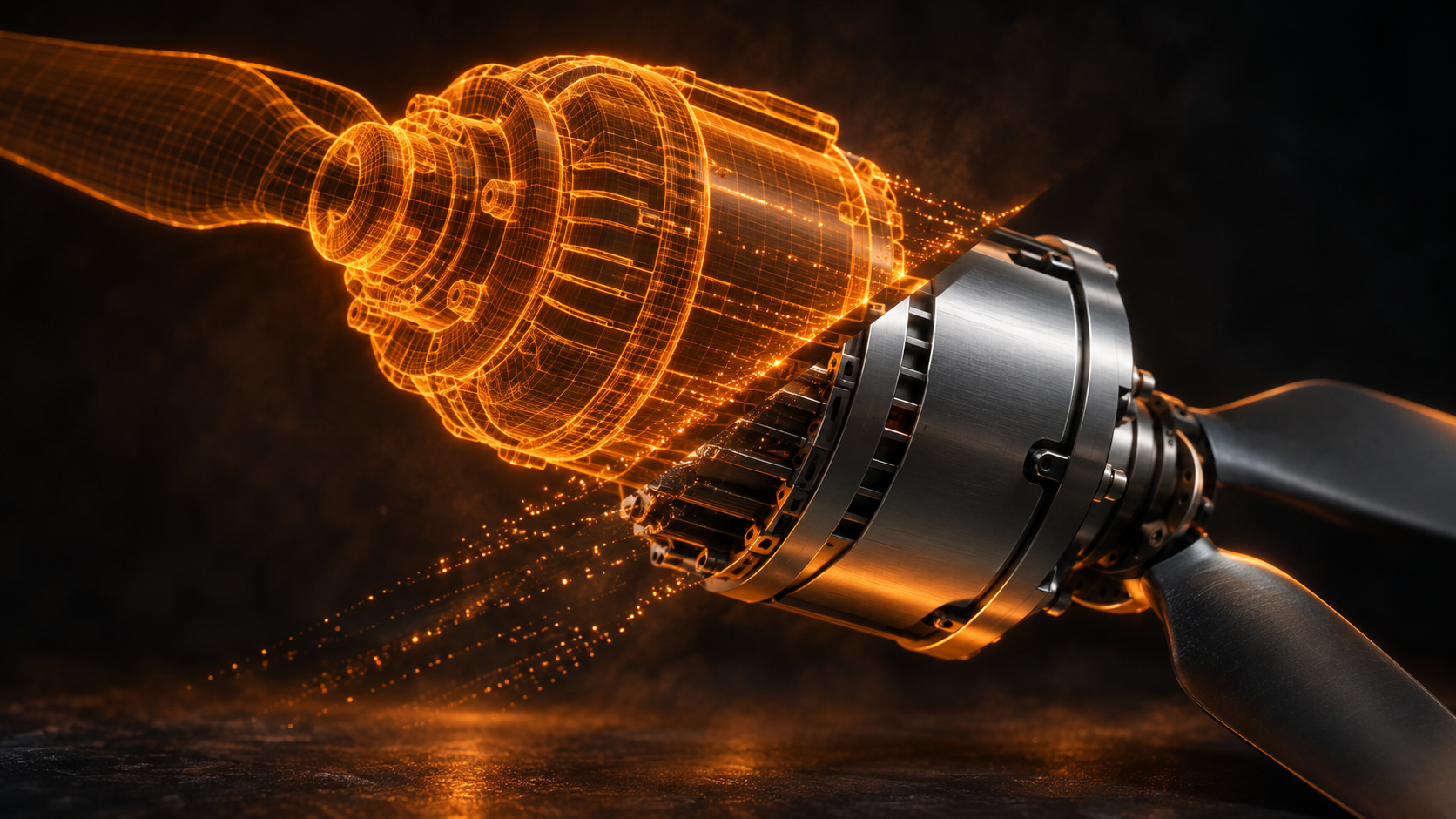
Rare-earth supply concentration exposes high-performance permanent-magnet propulsion to material and qualification risk. Company-level exposure depends on magnet chemistry, qualified suppliers, inventory and certification configuration control rather than motor count alone.

~70% — China's share of global rare-earth mining ~90% — China's share of rare-earth processing capacity ~93% — China's share of permanent-magnet manufacturing 0.1% — trace-material threshold in China's suspended December 2025 export-control rules November 10, 2026 — date through which China's broadest suspension currently runs
Rare-earth supply concentration can expose permanent-magnet propulsion programs to material, supplier and qualification risk. The aircraft-level exposure depends on magnet chemistry, motor design, qualified sources and inventory—not simply the number of motors installed.
Qualified alternative magnet sources, reduced heavy-rare-earth content, disclosed dual sourcing and propulsion designs that can tolerate approved material or supplier changes without disproportionate retesting.
High-performance electric aircraft motors commonly use rare-earth permanent magnets because they can deliver strong magnetic loading at low rotor mass. That creates a supply-chain dependency, particularly where neodymium-iron-boron magnets use dysprosium or terbium to preserve coercivity at elevated temperature. The engineering risk is not just access to raw rare earths; it extends through separation, alloying, magnet manufacture and qualification of the finished motor.
Public estimates place a large majority of rare-earth processing and permanent-magnet manufacturing capacity in China. Export-control policy has also changed repeatedly since 2025. Exact market-share and licensing figures are time-sensitive, so they should be dated and sourced rather than treated as permanent constants.
For an aircraft manufacturer, a delayed magnet shipment becomes a certification problem when an alternative material, grade or supplier changes the approved configuration. A replacement that is nominally the same size can differ in remanence, coercivity, temperature behavior, corrosion protection or manufacturing consistency. Those differences can affect torque, efficiency, thermal margin and demagnetization behavior.
More propulsion units can mean more individual magnet sets, but motor count alone does not determine kilograms of rare-earth material per aircraft. Total shaft power, motor topology, rotor dimensions, magnetic loading and magnet grade matter. A twelve-motor aircraft should therefore not automatically be described as twice as exposed as a six-motor aircraft.
Responses include qualifying additional magnet suppliers, reducing heavy-rare-earth content, changing thermal design, or selecting motor topologies that use fewer or no permanent magnets. Each option has system consequences. Induction or wound-field machines can reduce permanent-magnet dependence but introduce different rotor losses, control, cooling or mass trade-offs. A new magnet supplier may preserve topology but still require engineering validation and configuration-control work.
The key program question is whether alternative sources and material specifications are qualified before a disruption. Once a propulsion system is deep into conformity testing, an apparently small material substitution can create disproportionate retest and documentation work.
Useful evidence would include disclosed dual sourcing, qualified non-Chinese magnet capacity, motor designs tolerant of multiple approved grades, and certification plans that manage supplier changes without reopening large parts of the propulsion substantiation. Until developers disclose that information, the scale of company-specific exposure remains largely unknown.
This article addresses engineering and supply-chain risk, not investment performance.