Joby, Archer and Tesla patent documents describe engineering concepts in lift integration, battery thermal-event management and hybrid power electronics. The filings document claimed inventions; production configuration, certification acceptance and commercial value require separate evidence.
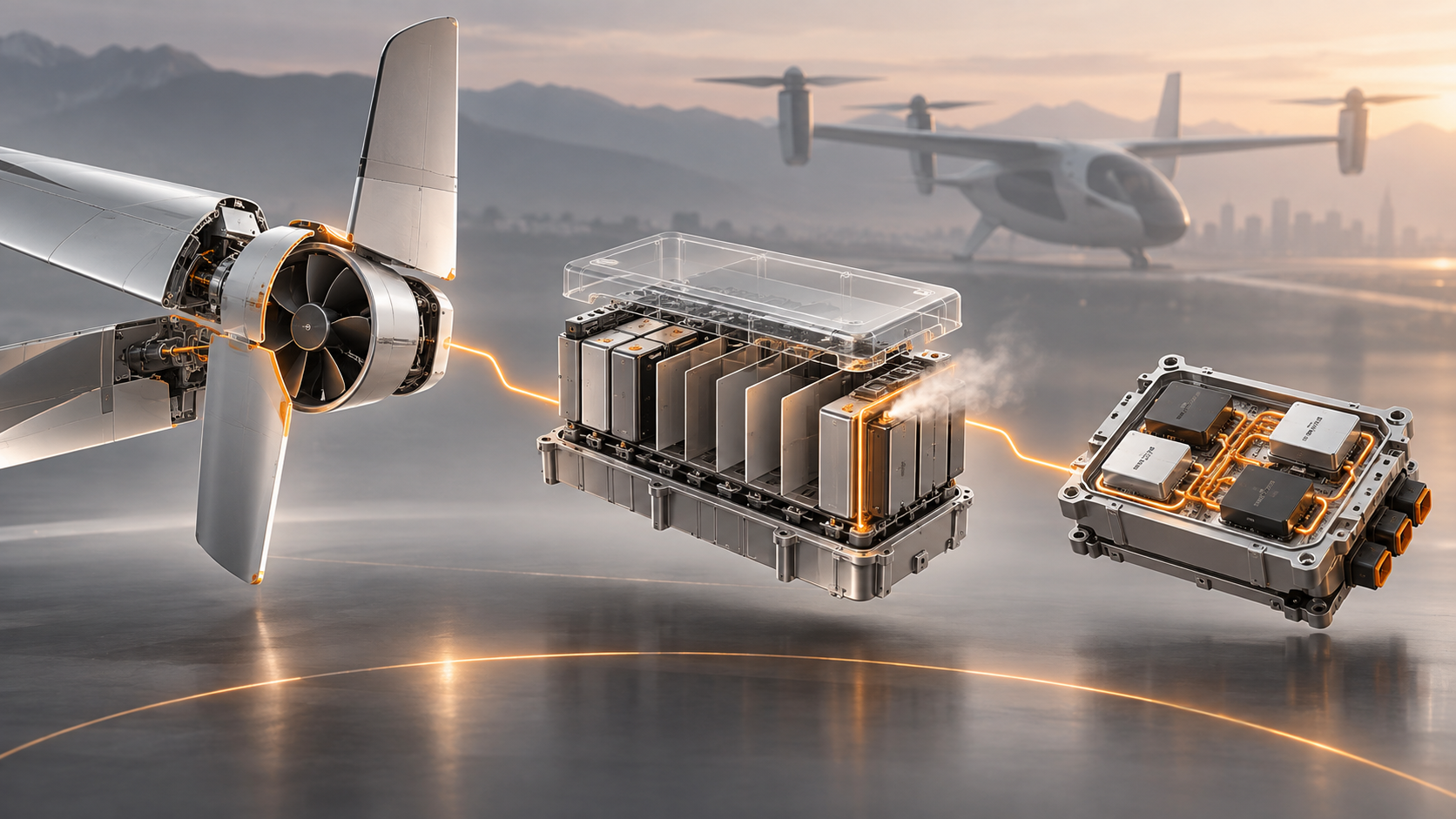
US Patent 12,280,868 — Joby wing patent, granted April 22, 2025 US Patent 12,617,542 — Archer battery patent, granted May 5, 2026 WO2026010828A1 — Tesla hybrid-inverter application, published January 8, 2026 (not yet granted) 100–250 kWh — pack sizes covered by Archer's patent ~2–3 IGBTs per SiC device — Tesla's hybrid inverter switching ratio
Patent documents expose claimed engineering concepts in unusual detail, but they do not prove that an assignee built every embodiment, selected it for production, obtained certification credit for it or created commercially valuable IP.
Implementation evidence: production-configuration disclosures, hardware and test data, certification documents, and—in Tesla's case—the eventual prosecution outcome of the published PCT application.
Patent documents are unusually detailed public engineering sources, but they are easy to overread. A patent describes claimed inventions and prior-art boundaries; it does not establish that the assignee built every embodiment, intends to commercialize it, or has demonstrated certification compliance. That distinction is central to reading three propulsion-adjacent filings from Joby, Archer and Tesla.
US Patent 12,280,868 describes a multi-element lifting system with integrated propulsion, including ducted propulsors and movable aerodynamic elements used to redirect flow and contribute control. The interesting engineering problem is coupling: one movable element can influence lift, thrust vectoring and aircraft moments, potentially reducing separate surfaces while increasing actuator, aero-propulsive and control-law interactions.
The patent does not establish that this architecture is the production configuration of Joby's S4. Its priority date is better interpreted as evidence that Joby's engineering organization explored and protected this design space.
US Patent 12,617,542 describes battery modules, thermal barriers and an outward venting concept in which an external fairing can provide a release path during a severe thermal event. The underlying safety problem is credible: a pack has to manage heat, gas, flame, pressure and propagation without creating unacceptable hazards elsewhere on the aircraft.
It is too strong to describe the concept simply as choosing “venting instead of containment.” Practical battery safety can require both local containment/isolation and controlled venting. Nor does the patent establish how the FAA is crediting the concept in Midnight's certification program. That would require certification-basis and compliance evidence beyond the patent.
WO2026010828A1 is a published PCT application, not a granted patent. It describes hybrid traction-inverter arrangements combining different semiconductor device types and control strategies intended to exploit their different loss, cost and fault characteristics.
The concept is relevant to aerospace power electronics because electric aircraft face the same broad switching-loss, thermal and fault-current trade-offs. Direct applicability is not established, however. Automotive duty cycles, redundancy, environmental qualification, voltage architecture and certification constraints differ from aircraft propulsion.
A granted patent establishes that claims survived examination under the applicable patent-law standards; it does not establish that the design is technically superior, economically valuable, in production or regulator-approved. A published application carries still more uncertainty because its claims can change during prosecution.
Used carefully, these documents reveal engineering options: integrated aero-propulsive control, thermal-event management and device-level inverter optimization. The next evidence tier is implementation—hardware disclosures, test data, certification documents and production configuration. Until that appears, the patents should be treated as technical signals rather than product roadmaps.
Not investment advice. No inference about company valuation or IP-portfolio value is intended.