Eight electric propulsion units (EPUs); redesigned wing/propeller architecture succeeding the earlier VX4 tilt-rotor layout.
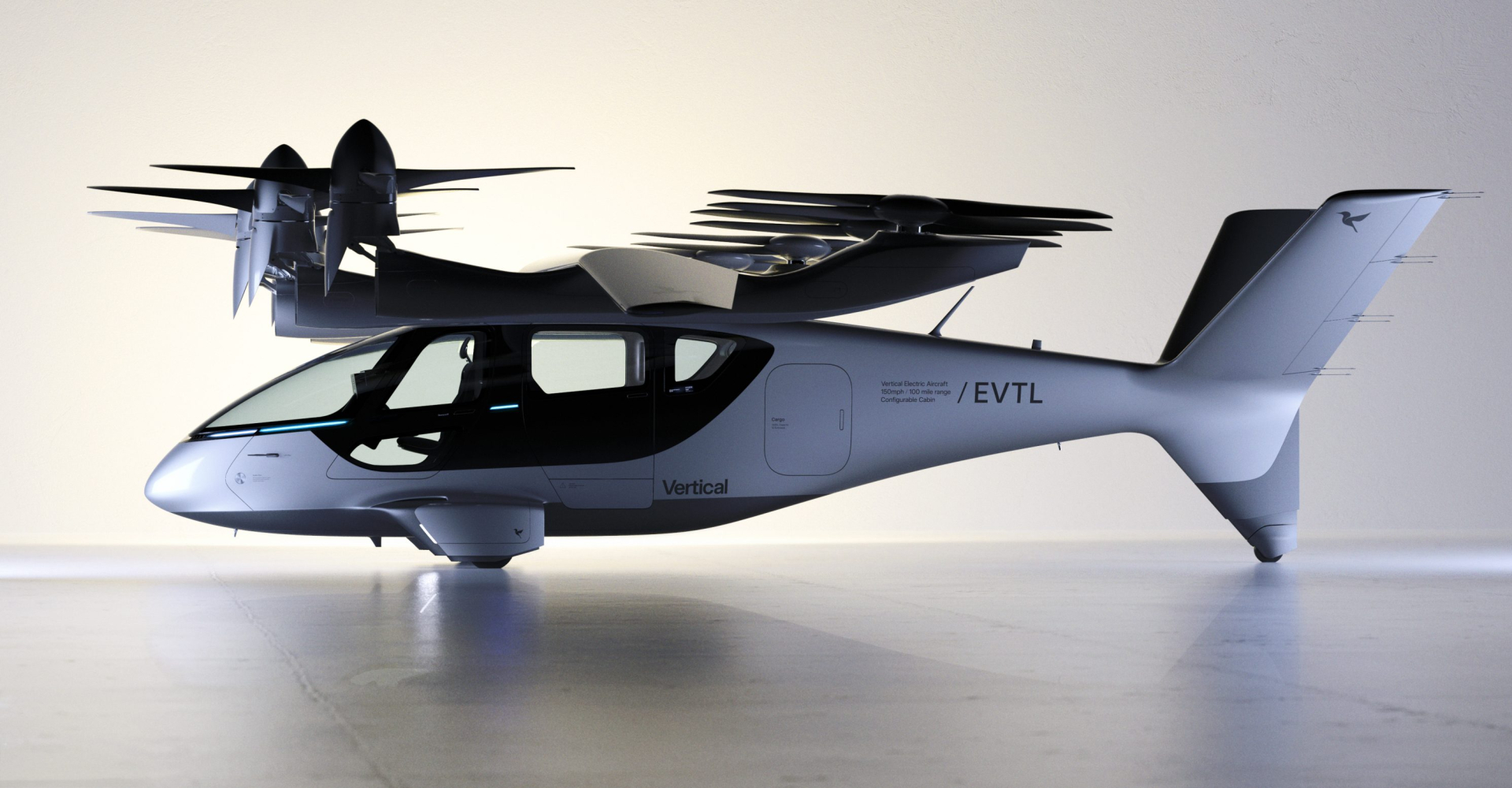
Propulsion Unit Count
8
Redundancy Approach
Eight liquid-cooled underfloor battery packs; each EPU carries multiple electrically isolated power lanes.
Range / Speed
Company target: up to 100 mi range; 150 mph cruise. Cabin designed for up to 6 passengers.
Seat Count
6
Last Updated
September 25, 2026
Three full-scale prototypes have flown piloted transition. Vertical targets Critical Design Review by end-2026 and type certification in 2029, and opened a Valo assembly centre at Cotswold Airport on 25 September 2026. A strategic review launched on 24 September 2026 adds funding and structural uncertainty.
Complete Critical Design Review by end-2026 and begin assembling certification-conforming aircraft at Kemble in Q4 2027, subject to the outcome of the strategic review.
Valo is Vertical Aerospace’s current commercial eVTOL design, succeeding the VX4 prototype configuration. It is a piloted, winged, battery-electric VTOL intended for passenger transport and other missions. Vertical’s current design material describes a launch cabin with four passenger seats and a flexible architecture capable of expansion to six passengers.
PropulsionWatch classifies Valo at Certification: a full-scale piloted prototype campaign is active and the UK CAA is the primary certification authority, with EASA validation/co-operation also part of the program. A Type Certificate has not been issued.
The published Valo architecture uses eight electric propulsion units and eight liquid-cooled under-floor battery packs. Vertical states that each EPU is fed by multiple electrically isolated power lanes. The aircraft retains a winged transition configuration derived from the earlier VX4 test program but introduces a redesigned airframe, wing, propeller and battery installation.
Company target figures are up to 100 miles of range and up to 150 mph. These are design targets, not certified operating performance. The current public design describes a flexible cabin for four passengers at launch with expansion to six passengers, while final certified capacity remains subject to the approved configuration.
Vertical’s 2026 piloted flight-test campaign progressed through thrustborne, wingborne and transition flight. Its August 2026 SEC-filed H1 update stated that two full-scale aircraft had achieved piloted transition; the third full-scale prototype, which first flew in June, subsequently progressed through the same sequence.
The program is now focused on completing Critical Design Review by the end of 2026. Vertical says CDR will establish the certifiable design baseline and enable construction and testing of certification-conforming aircraft. The company re-baselined its prior schedule and now expects Valo type certification in 2029. That date is company guidance, not a regulator commitment.
Vertical is developing Valo for commercial passenger service, including airport-to-city and regional missions, with additional cargo, EMS, hybrid-electric and uncrewed variants discussed for the platform. The company reports a substantial pre-order book, but those commercial commitments are not aircraft deliveries and do not constitute regulatory approval to carry passengers.
Prototype demonstrations at Farnborough and flights between UK civil and military airports are flight-test and demonstration evidence. They are not entry into public passenger service.
The immediate technical dependency is configuration maturity: CDR must establish the certifiable design baseline before certification-conforming aircraft can be built and used for formal compliance demonstration. Remaining dependencies include conformity, system and structural compliance evidence, battery and electric-propulsion qualification, UK CAA verification, EASA validation activity, production approval and the operating framework required for commercial VTOL service.
Vertical’s revised 2029 certification expectation is a company program schedule and may change as the remaining certification workscope is completed.
SEC / company filing — 13 Aug 2026: Vertical Aerospace, “H1 2026 Business Update,” filed as Exhibit 99.1. Records piloted transition progress, upcoming CDR and certification/manufacturing work. Source.
SEC / company filing — Aug 2026: H1 filing describes the third prototype and states that the program was re-baselined from the prior 2028 target to an expected 2029 Type Certificate. Source.
Manufacturer technical release — 10 Dec 2025: Vertical Aerospace, “Vertical Aerospace unveils Valo,” for current configuration, battery/EPU architecture and target performance. Source.
Regulator framework — UK CAA: the CAA states that commercial VTOL aircraft require UK Type Certification or validation and that UK.SC.VTOL is the intended certification basis for new VTOL types. Source.
September 25, 2026