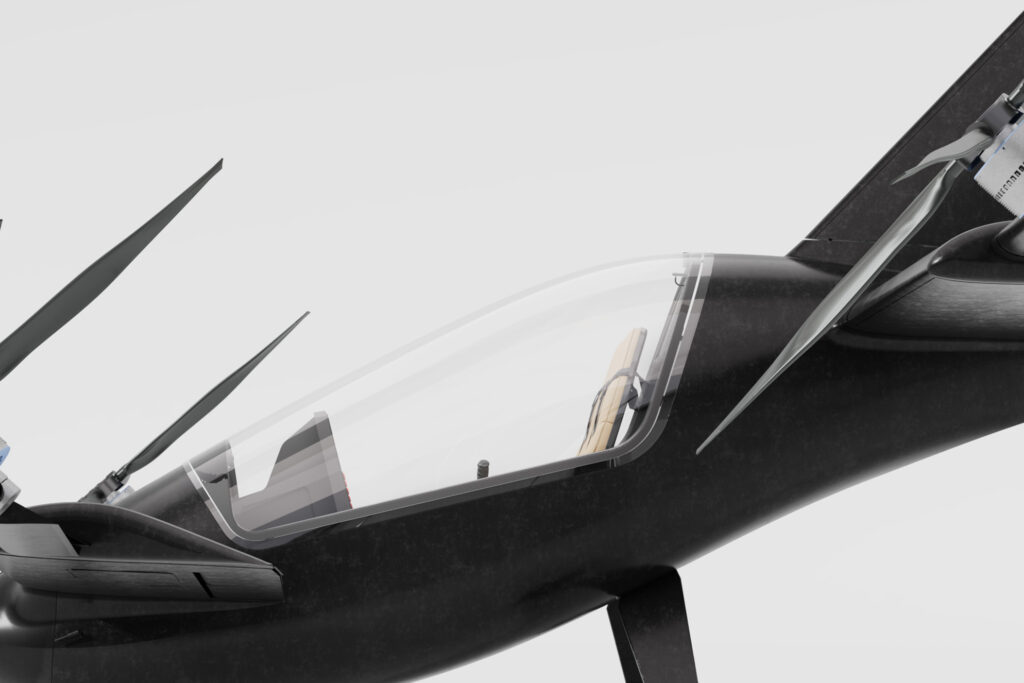
Battery-electric tandem-wing aircraft: four fixed-angle propellers driven by eight motors (two motors per propeller). Wings and nacelles do not tilt.
Propulsion Unit Count
4
Redundancy Approach
Manufacturer describes paired motors, three flight-control systems, separate battery clusters and mechanical flight-control linkages. These claims do not establish independence of every aircraft-level failure path.
Range / Speed
Preliminary company cruise speed: 87 kt / 100 mph. Range and battery figures conflict across current manufacturer pages and are not normalized here.
Seat Count
2
Last Updated
October 21, 2026
Skyfly reports more than 100 piloted prototype flights and experimental permits in the UK and US. Its $10m seed round is intended to fund light-sport conformity and production. First deliveries in 2027 remain a company target; no completed production-aircraft approval is asserted.
Document the applicable FAA-accepted standards and aircraft conformity, secure required airworthiness issuance and demonstrate repeatable production readiness.
Axe is Skyfly's two-seat battery-electric vertically capable aircraft. The public production concept combines a short central fuselage, two fixed lifting wings, four outboard propellers and tricycle landing gear. Eight motors drive four propellers; propulsion-unit count here counts propellers, not motors.
The nacelles remain at a fixed angle. Forward flight uses wing lift without nacelle or wing rotation. Skyfly describes mechanical surface controls and redundant flight-control functions. Their detailed installation and full failure assessment are not public.
The October technical sheet lists 5 m spans for both wings, 8.205 m overall width including propellers, 4.395 m length, 750 kg MTOM and four 1.9 m four-blade propellers. All figures are preliminary manufacturer data.
The 20 October 2026 company announcement reports a $10m seed round led by HICO Investment Group with Archangel participation. Skyfly reports more than 100 piloted prototype flights and experimental permits in both countries. Funding is intended for aircraft conformity, industrial capacity and a separate hybrid derivative. The 2027 delivery date is a target.
Axe targets private owners and potential training uses. Permitted operations, pilot qualifications and site access depend on the final aircraft approval and local rules. The Longbow hybrid uncrewed development is not represented as an approved Axe variant.
The October PDF gives 60 kWh while the product page gives 70 kWh. The PDF specifies an estimated 100+ nautical-mile maximum without reserve, whereas the FAQ uses 100 statute miles. Battery capacity and range fields remain blank pending manufacturer clarification. Useful load includes occupants and baggage; it is not a cargo payload rating.
The 3D view is an exterior interpretation from official imagery and published dimensions, with schematic internal function markers. Blade speed and aircraft attitude are explanatory; nacelles never tilt.
Official product page and imagery; configuration and conformity FAQ; October preliminary technical sheet; 20 October funding announcement; FAA MOSAIC framework. Review: 21 October 2026. Performance and test-count claims are company-reported.
October 21, 2026