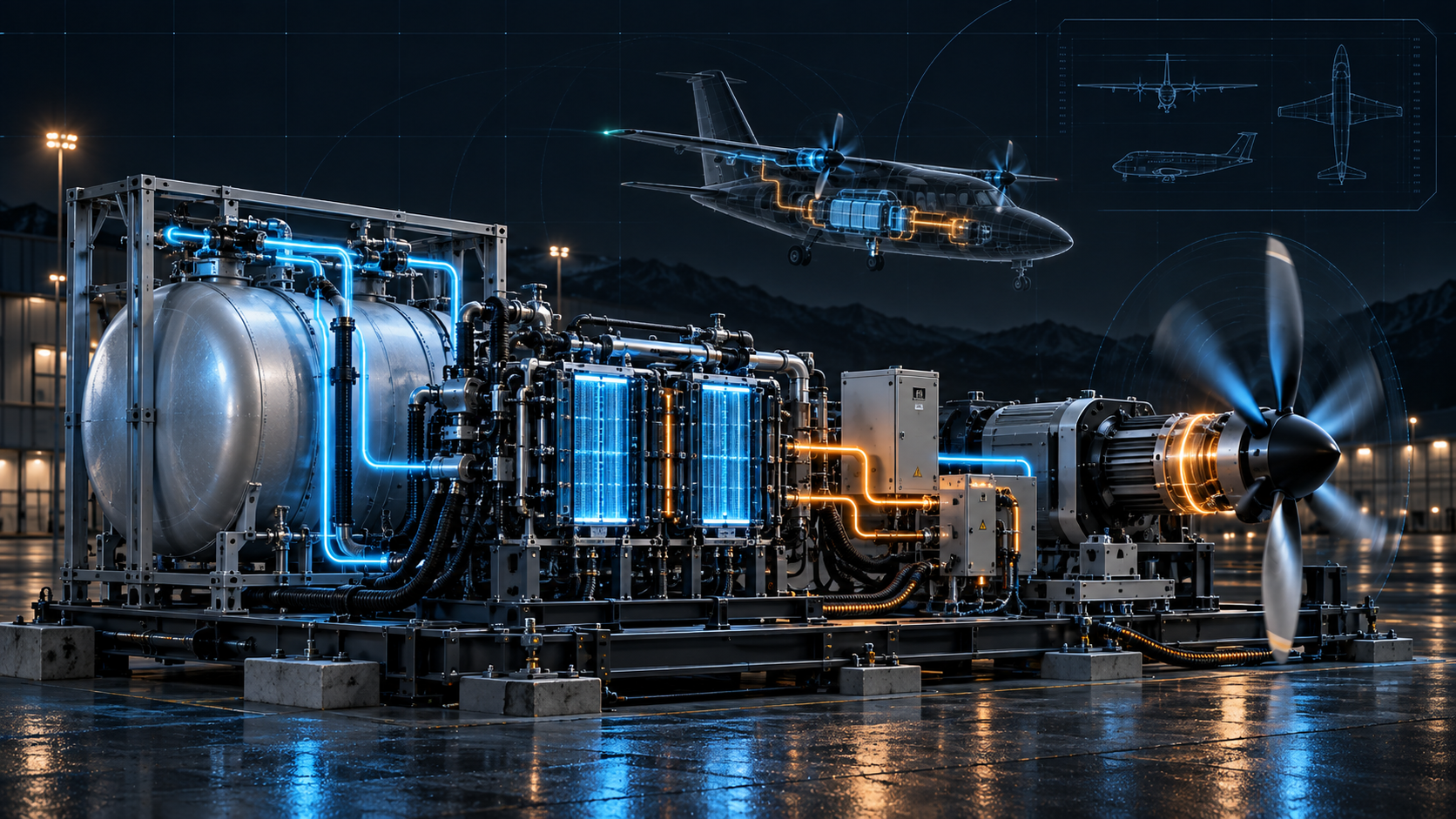
Research reference aircraft using liquid-hydrogen fuel cells to supply electric propulsion. Clean Aviation describes two electrically driven propellers, with the fuel-cell system and LH₂ tank integrated in the rear fuselage; NEWBORN develops the scalable fuel-cell power source and hybrid fuel-cell/battery ground demonstrator.
Propulsion Unit Count
2
Redundancy Approach
The public reference concept has two electric propellers and a hybridized fuel-cell/battery energy architecture, but certification-level redundancy, fault isolation and common-mode failure provisions are not yet publicly defined.
Range / Speed
Research-concept targets: 189 nm per short hop, 945 nm across five hops before refuelling, and Mach 0.23 cruise. These are concept-level design assumptions, not demonstrated aircraft performance.
Seat Count
19
Last Updated
September 22, 2026
The Pipistrel Miniliner is a 19-passenger hydrogen-electric research reference aircraft used for NEWBORN integration studies. The aircraft itself is not in flight test or certification; current evidence is at concept and propulsion ground-demonstrator level.
Complete NEWBORN's integrated fuel-cell/battery/megawatt-electric-propulsion ground demonstration and publish aircraft-level integration evidence showing how the power system maps into a representative 19-seat configuration.
The Miniliner is a 19-passenger hydrogen-electric commuter research concept originating in UNIFIER19 and refined through Clean Aviation work including NEWBORN. It is used as the CS-23 reference aircraft for assessing how a megawatt-class fuel-cell propulsion system could be integrated into a small commuter aircraft.
It should be read as an integration reference, not as a certificated Pipistrel product or a current flight-test aircraft.
Clean Aviation describes a conventional tube-and-wing configuration with a T-tail and two electrically driven propellers. The fuel-cell system and liquid-hydrogen tank are positioned in the rear fuselage in the published reference concept.
NEWBORN's propulsion work combines a hydrogen fuel-cell power source with high-voltage power electronics, battery buffering and megawatt-class electric propulsion. Final aircraft-level redundancy, thermal architecture and certification implementation remain under research.
NEWBORN has defined aircraft-integration concepts for the CS-23 Miniliner and progressed the propulsion technology through subsystem integration and ground testing. On 22 September 2026, ÚJV Řež reported completion of a key ground-test phase for the integrated hydrogen power source at approximately 700 kW.
The next project phase is planned in Gorizia, Italy, where the hydrogen source is to be integrated with battery systems and a megawatt-class electric propulsion system for complete demonstrator ground testing.
The Clean Aviation reference mission uses 19 passengers and short regional hops. Published concept figures include 189 nm per hop and 945 nm across five hops before refuelling, with Mach 0.23 cruise. These are research assumptions used to size and assess the concept rather than certified operating specifications.
The immediate dependencies are complete-system ground demonstration, aircraft-level mass and thermal integration, liquid-hydrogen storage and distribution, high-voltage fault management, and a certification approach for megawatt-class fuel-cell propulsion. No public evidence currently establishes a flight-test or type-certification program for the Miniliner concept.
Clean Aviation Annual Activity Report 2024: identifies the Pipistrel Miniliner fuel-cell concept, 19-passenger reference mission, two electric propellers and concept-level range/speed assumptions. Source.
Clean Aviation NEWBORN overview: documents the CS-23 Miniliner integration concept and scalable 1 MW fuel-cell module objective. Source.
ÚJV Řež — 22 Sep 2026: reports approximately 700 kW during the completed integrated hydrogen power-source ground-test phase and the move toward full demonstrator integration in Gorizia. Source.
September 22, 2026