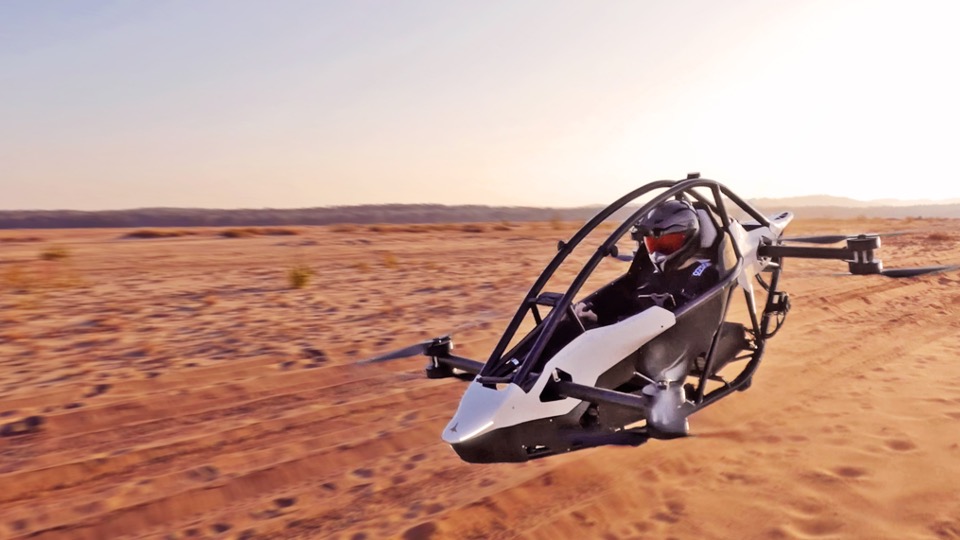
Eight fixed electric rotors arranged in four coaxial counter-rotating pairs; open single-seat multicopter.
Propulsion Unit Count
8
Redundancy Approach
Company describes motor-out capability; public configuration alone does not establish independent power paths or a validated failure envelope.
Range / Speed
Company product page: approximately 20 minutes flight time; software-limited 102 km/h. Conditions, reserves and configuration affect usable performance.
Seat Count
1
Last Updated
October 27, 2026
Jetson reports customer deliveries from September 2025 and Italian ultralight identification in June 2026. Florida Polytechnic independently confirms an acquisition for evaluation, while approval for its intended operational use remains pending. These are distinct from conventional aircraft Type Certification.
Substantiate configuration-specific mass and performance; obtain permissions appropriate to each intended jurisdiction and use.
Jetson ONE is a piloted, single-seat battery-electric multicopter. Four fixed coaxial columns carry eight rotors. It has no wing-borne cruise or tilting nacelle mode.
Official photography shows an open protective spaceframe, one seat, white fairings, skid supports and four pairs of two-bladed propellers. The detailed product page lists 2,700 × 1,600 × 1,120 mm and a folded width of 980 mm.
Mass discrepancy: the detailed page lists 115 kg including batteries and 55 kg empty; the homepage lists 86 kg. These figures are not normalized into a comparable MTOW. The company also lists an approximately 20-minute duration and 102 km/h software-limited speed, rather than certified mission performance.
Jetson announced its first customer delivery to Palmer Luckey on 5 September 2025. Its 13 August 2026 release reports Italian AeCI ultralight identification I-E953, issued on 17 June 2026; the underlying authority document has not been independently reviewed here.
Florida Polytechnic announced acquisition of a Jetson ONE for public-safety evaluation on 20 October 2026. The university expressly states that FAA approval for operational use is being sought.
The manufacturer's US Part 103 positioning and Italian ultralight identification concern specific legal pathways. They do not establish an EASA Type Certificate, general commercial passenger authorization, or approval for the university's planned public-safety operations.
Key evidence gaps are reconciliation of published mass/configuration, usable mission reserves, installation-level power segregation and permissions for specific operations. Published manufacturer safety claims should not be read as independent validation.
October 27, 2026