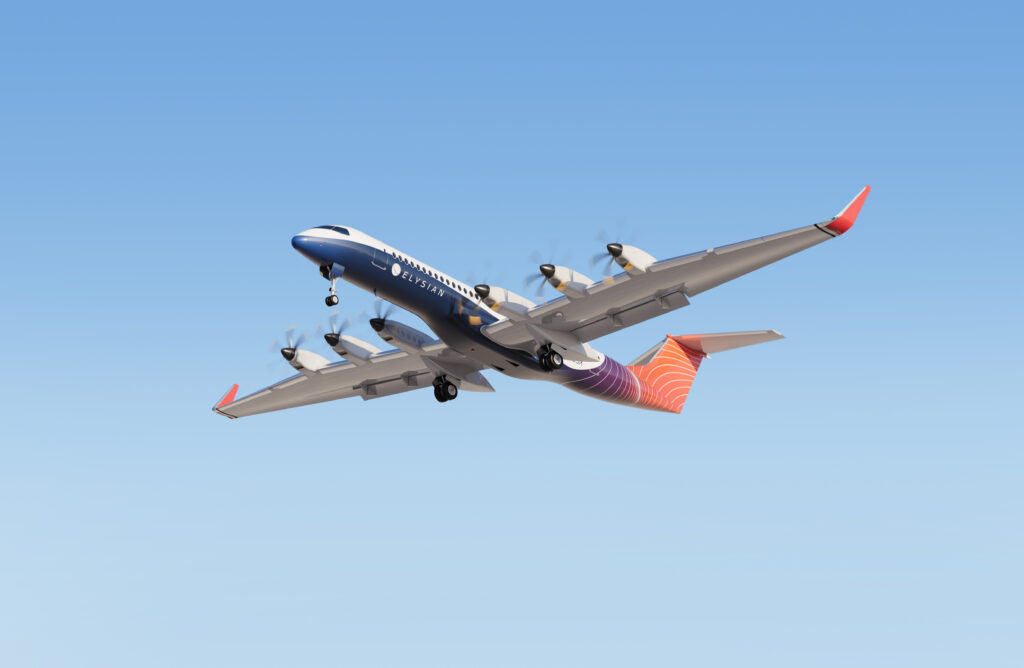
Revised six-propeller electric concept with wing batteries and a fuel-based reserve-energy system; nominal missions are intended to use battery energy.
Propulsion Unit Count
6
Redundancy Approach
Distributed propulsion and reserve-power architecture remain under design. A published sizing study evaluates failure cases; it does not establish approved aircraft-level redundancy.
Range / Speed
Manufacturer target: 750 km, with a path toward 1,000 km. Current capacity positioning is 88–100 seats; the technical reference is a 90-seat study. No certified range is claimed.
Seat Count
90
Last Updated
October 22, 2026
Elysian's 10 April 2026 release reports Conceptual Design Review completion and first scaled-demonstrator flight. The revised public concept replaces earlier eight-propeller imagery with six propellers. No full-scale flight or Type Certificate is established here.
Mature wing/battery, power-distribution, reserve-system and folding-tip designs; demonstrate full-scale integration and substantiate certification plans.
E9X is a regional-aircraft development concept. The current manufacturer positioning is 88–100 seats. This dossier and model use the newer six-propeller study, rather than the early eight-propeller configuration.
Figure 5 of the author-hosted redesign paper provides a 35 m length, 52 m span and six 4.2 m propellers. The T-tail and wing fold locations at ±18 m guide the representative exterior model.
Wing-integrated batteries support nominal missions. The study places a fuel-based reserve-energy system in the aft belly. Equipment blocks in the Explorer show functions, not an exact installation.
On 10 April 2026 Elysian reported conceptual review completion and a first scaled-demonstrator flight. It also described wing-integration, battery and high-voltage demonstrators. These are distinct from flying or certifying the full-size passenger aircraft.
The intended market is short-haul regional service. The manufacturer publishes a 750 km mission target and a longer-term path to 1,000 km. Neither is entered as demonstrated or certified performance.
Wing battery integration, electrical distribution, reserve-system segregation and large folding tips require engineering and certification evidence. Seat count 90 identifies the paper's reference case; current marketing gives a broader cabin range. The model's blade shape, cabin and internal equipment remain approximate.
April 2026 programme release; Elysian/TU Delft redesign study, Figure 5; current manufacturer positioning. Sources reviewed 22 October 2026; research assumptions and targets remain labelled accordingly.
October 22, 2026