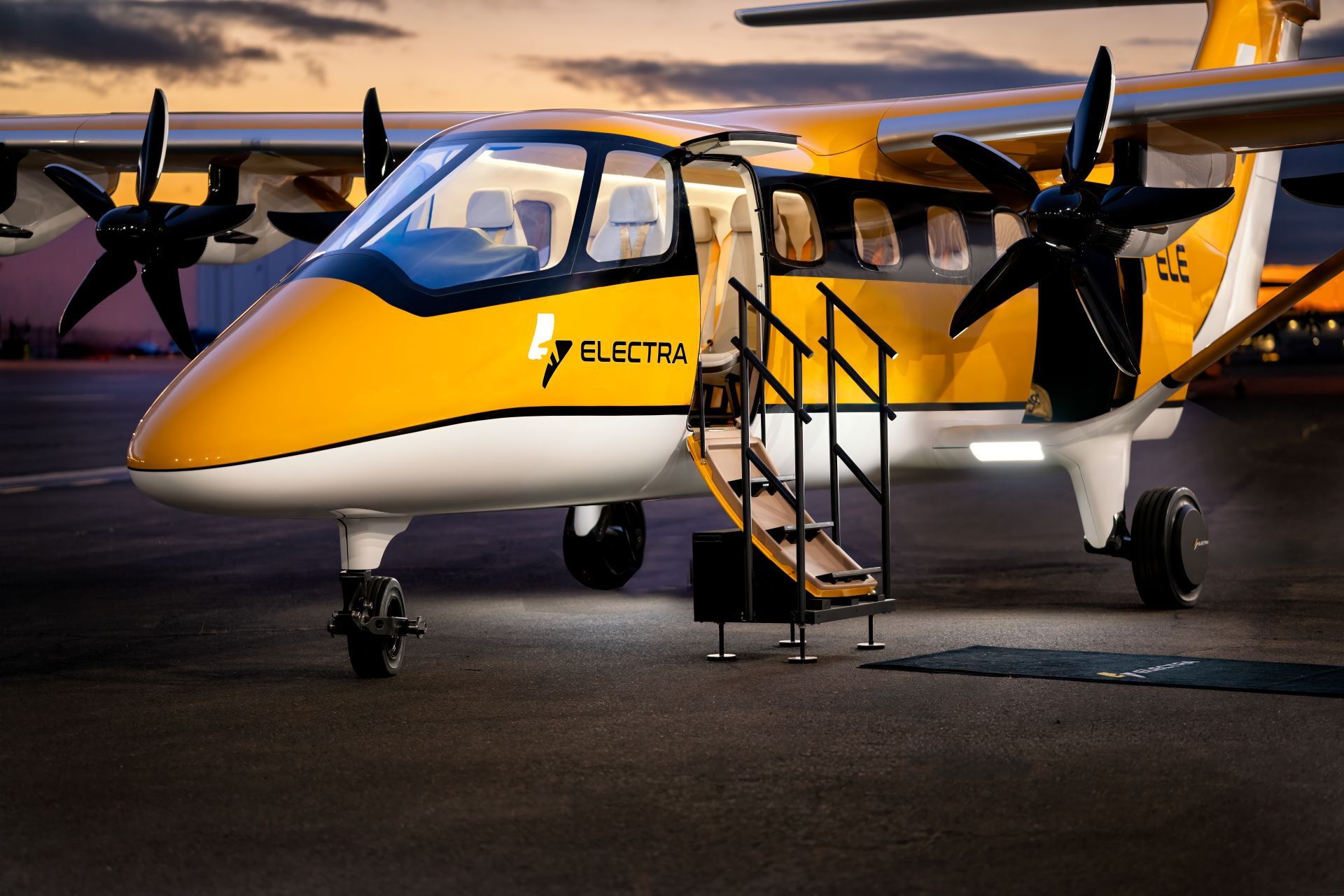
Hybrid-electric blown-lift airplane using eight distributed electric propulsion units along the wing, four independent battery packs and a Safran TG600 turbogenerator supplying onboard electrical power.
Propulsion Unit Count
8
Redundancy Approach
Four independent battery packs support distributed electric propulsion; eight EPUs distribute thrust along the wing. Electra also uses fly-by-wire flight controls. Full certification-level common-mode and system-partitioning detail is not fully public.
Range / Speed
Company-published design targets: 330 nm mission range; 1,100 nm maximum ferry range with IFR reserves; 175 kt cruise; takeoff and landing in as little as 150 ft. Nine-passenger configuration.
Seat Count
9
Last Updated
September 18, 2026
EL9 is in formal FAA Part 23 certification after closure of its G-1 Issue Paper on 10 July 2026 established the certification basis. The full-scale EL9 has not yet flown. Electra's September 2026 Atlas agreement starts airframe industrialization for flight-test and certification aircraft, with first airframe deliveries expected in 2027 and commercial entry into service targeted for 2030.
Complete detailed design and receive the first Atlas-built flight-test/certification airframes, then begin full-scale flight testing and FAA compliance demonstration against the agreed Part 23 certification basis.
Electra’s EL9 is a piloted nine-passenger hybrid-electric ultra-short-takeoff airplane. It is not an eVTOL: lift is produced aerodynamically by the wing, with distributed propellers blowing the wing to generate high lift at low airspeed and support takeoff and landing in very short distances.
Electra applied for FAA Part 23 type certification in November 2025. On 10 July 2026 the company reported that the FAA had closed the G-1 Issue Paper, establishing the EL9 certification basis. PropulsionWatch therefore classifies EL9 as a certification-stage program, while distinguishing that regulatory milestone from Type Certificate issuance.
The EL9 uses eight distributed electric propulsion units along the wing. Electra selected Evolito to supply integrated electric propulsion units incorporating motors, motor controllers and thermal control. Four independent battery packs provide electrical energy and a Safran TG600 turbogenerator supplies onboard power for the hybrid-electric architecture.
Blown-lift aerodynamics and fly-by-wire controls are central to the aircraft’s low-speed operating concept. Electra publishes design figures of 150 ft takeoff and landing distance, 175 kt cruise, a 330 nm passenger/cargo mission range and a 1,100 nm maximum ferry range with IFR reserves. Those figures are manufacturer specifications and remain subject to the certified configuration.
Electra submitted the EL9 Part 23 application in November 2025 and reported FAA closure of the G-1 Issue Paper on 10 July 2026. Five days later Electra and Safran announced a life-of-program agreement for the TG600 turbogenerator.
On 15 September 2026 Electra and Atlas announced an airframe manufacturing agreement for EL9 flight-test and certification aircraft. Atlas is scheduled to begin work in September 2026, with first airframe deliveries expected in 2027. Electra’s current commercial entry-into-service target is 2030. The full-scale EL9 has not yet entered flight test, so the next evidence threshold is production of the certification test fleet and subsequent FAA compliance testing.
Electra is positioning EL9 for regional passenger and cargo missions from airports and other sites that can support its short ground roll. Bristow signed a pre-delivery-payment agreement in January 2026 covering five aircraft, including the first delivery slot, with options for 45 more; the agreement is explicitly subject to aircraft certification.
Announced operators, production plans and 2030 service-entry guidance are commercial program evidence rather than regulatory approval. Routine passenger or cargo service remains dependent on aircraft certification, production approval, operator approvals and the suitability of each intended operating site.
The immediate program dependency is transition from certification-basis definition into a full-scale aircraft test and compliance campaign. Remaining work includes completion of detailed design, manufacture of flight-test and conformity-relevant aircraft, qualification of the hybrid-electric propulsion system and energy storage, structural and systems compliance, flight testing, and FAA verification leading to a Type Certificate.
Electra’s 2030 entry-into-service date is company guidance. It depends on certification progress, production-system maturation and the operating approvals required by customers in each market.
Manufacturer certification update — 10 Jul 2026: Electra reports FAA closure of the G-1 Issue Paper, establishing the EL9 Part 23 certification basis. Source.
Manufacturer propulsion agreement — 15 Jul 2026: Electra and Safran announce the TG600 turbogenerator production agreement and current 2030 service-entry guidance. Source.
Manufacturer industrialization update — 15 Sep 2026: Electra and Atlas announce EL9 airframe manufacturing for flight-test and certification aircraft, with first airframe deliveries expected in 2027. Source.
Manufacturer propulsion supplier update — 13 Oct 2025: Electra identifies Evolito as supplier of the eight electric propulsion units. Source.
Evidence classification: FAA G-1 closure is reported by Electra and establishes a certification basis; it is not a Type Certificate. Performance and schedule figures are manufacturer-published targets.
September 18, 2026